The heat had come back. And with it, David Attenborough. When the simple act of making a decision caused me to break a sweat, I returned to my tried and true method of beating the heat: watching the BBC documentary, 'Blue Planet.' The underwater photography creates a psychological feeling of coolness, as if you yourself are underwater.
Deciding then that all the sitting around contained the risk of my taking on the size of the cetaceans drifting across my TV screen, it was time for a walk.
I chose the Takenouchi Kaidō, which is just north of the Katsuragi Kaido that I had walked in June. I left the train in one of those bedroom towns that are the cul-de-sac of dreams. Today was the official start to Obon, and the few people I passed were gearing up for the holiday, carrying flowers and decorating graves and jizo. At the corner in front of a school was a makeshift site with flowers, drinks, and two crossed baseball bats. I'm guessing that a child had been hit by a car here, poor thing.
The town seemed to take great pride in this Kaido, which goes back to the year 613. There were frequent stone markers and, like other old Osaka roads, the asphalt was a different color than usual, making it very easy to follow. In fact it followed a different route than that in my guidebook, one that mercifully kept me off of busy roads for the most part. It led me out of the new town and climbed a narrow road lined on both sides with Edo-style homes that had probably been inns for travelers. Above this was a small museum with displays on the Kaidō's history.
Leaving the 19th Century, I came to the inevitable busy road that I was forced to follow up and over the pass. It was a dismal hour, but for the stones and Buddhas at the top. Just below, I passed a guy dressed like a civil servant, wearing the wrong shoes and holding a newspaper close to his face like he was on the train. A couple times a year I'll come across people like this, who look suspiciously out of place, and it spooks me every time.
Once on the other side of the pass I was in Edo again. There was a small museum to Basho, who had also walked this route. The banana tree in the garden was a nice touch. At the bottom of the road was a magical forest. I expected to find a shrine under the dark trees, but there was none. Bizarre, this ancient grove in the middle of prime suburban real estate.
As if on cue, the valley in front of me was fast filling with storm. The Katsuragi peaks looked their part as the lair of wizards. As I waited for my train, I felt that this road, despite its age, had been minor, though it served as a nice 2 hour diversion. And here at the end of this post, I feel like I have nothing new to add; these walks are starting to get more and more similar. There was the usual busy road, the obligatory beautifully maintained street, the typical confusion.
It was at that moment that I saw the Tengu...
On the turntable: Miles Davis, "Complete Miles at Montreaux"
On the nighttable: Frederik L. Schodt, "Native American in the Land of the Shogun"
Here we are on the cusp of Obon. I thought I'd exhume a piece I wrote about the holiday back in 1998, which netted me first prize in a writing contest. It's a pdf link, so click and scroll down to page 10.
Please forgive the cheesy photo and lousy title...
"An Interview with film-makers Roger Walch and Ted Taylor
I love film-making… I love to think of
stories, to make a film, to edit a film, to put the sound track
together… And as soon as I’m finshed with a film. I want to do the next
one…
(Roger Walch)
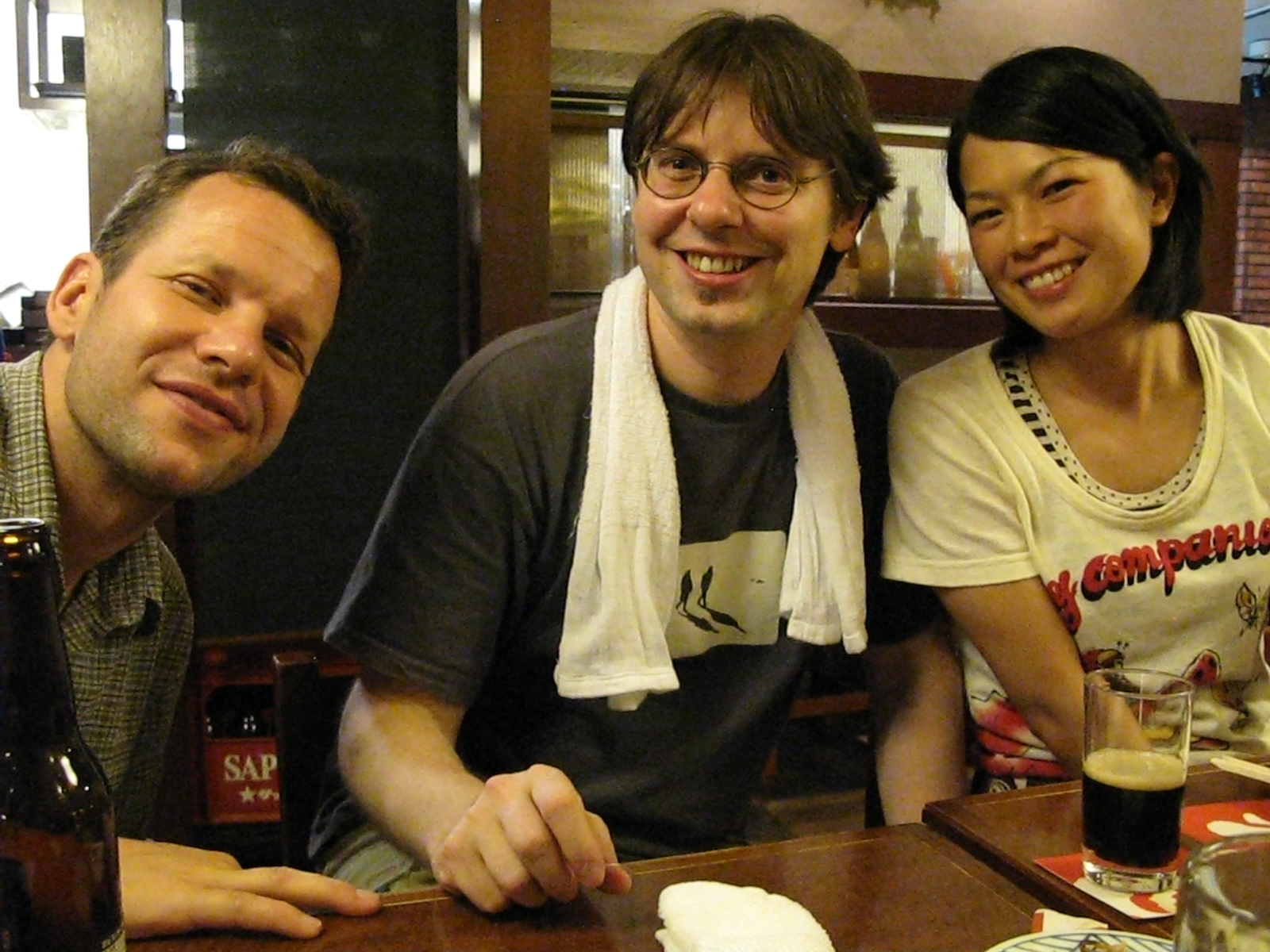
Left to right, Thomas Cramer (sound, lighting and still photography), Roger Walch (director), Lili Sakamoto (actress).
Last week Ted Taylor invited me to dinner with the makers of the movie “Tengu” in the izakaya “Tengu” (do you see what they did there?).
I spoke to Ted and to the director Roger Walch about their new film
project: “Children of Water”. They had just completed a long day
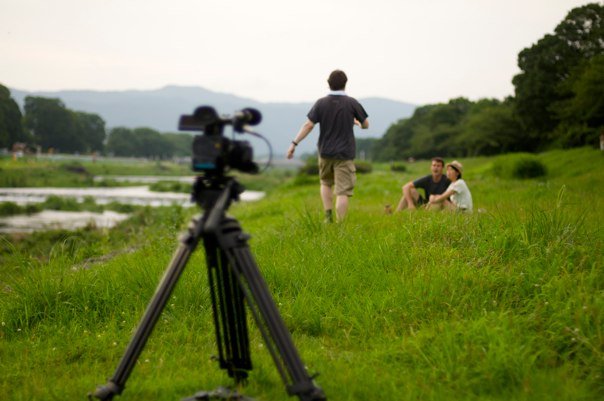
location shooting at Itami airport, the Kamo river, Yoshida yama, and in
front of Tengu. Though tired, over a bite to eat and a few beers they
waxed enthusiastic about their new movie. Roger explains the plot as
follows:
After one year in an ESL-course in the US a Japanese graphic
designer returns to Japan and discovers that she is pregnant. She
contemplates abortion, but her American boyfriend strongly opposes and
flies to Japan to convince her to keep the baby. During his stay he not
only gets to know life and customs in Japan but also different moral and
religious values.
Ted: It’s a cross-cultural thing. He’s trying to
come back and save the relationship and he wants to have the kid, but
she thinks he comes to support her. She thinks he’s coming to be kind
like “oh I’m gonna come with you and be at your side while you have it”.
You know. Whereas, he’s coming to prevent her from having it and
convince her to come back to the US, she’s more businesslike about it, Michael: She’s already decided? Ted: She’s more black and white about it, right. And
he’s more like no, no, no! He’s there to keep the relationship alive and
she’s just dealing with the baby situation so again they’re not
communicating. Roger was saying first he was just gonna do rooms and
shooting in rooms, but now he wants to shoot a couple of days around
Kyoto because he said, well you know we should show some Kyoto… He is
using this as a platform to show more about Japanese culture – so things
related to children and the death of children like jizo [see note at end of article] and kokeshi… Michael: Kokeshi? Ted: Kokeshi is like – you know those kokeshi dolls. Michael: Yeah. How do they relate to that? Ted: Um, in particular up in Tohoku, in the old days
when farm families didn’t have enough, they would have an unwanted
child, and they couldn’t feed it and they would basically starve it to
death or kill it. They would get a kokeshi doll that would basically be a
representation like the spirit of the kokeshi doll is actually in… Michael: That’s where kokeshi dolls come from? That’s horrific! I thought they were just like cute little dolls. Ted: Yeah. Exactly and that’s the reaction I think. And
that’s why… the Tohoku region is basically putting the kabash on that,
they are really keeping that fact underground now because kokeshi dolls
are considered a folk art for that region. A lot of tourism is based on
people buying that as omiyage. So were people to know these represent
the spirit of a child, people would not be buying these things… “Ko” [子]
is child and “keshi”is like kesu [消す]. Roger: Kesu. Like “erase a child”. Michael: It gets creepier every time you talk about it! Roger: You can hardly find any reference to it on the internet because in northern Japan they are now – Michael: How did you find out about it? Roger: It’s just logic. You look at the name. The Japanese characters. Michael: But to find out that that’s what it was for you must have done some research. Roger: Some Japanese told me and … it’s like the ubasuteyamas [姥捨], you know. Where you throw away your grandmother in the mountains… Michael: There was a short story… Roger: Yeah, Narayama Bushiko “The Ballad of Narayama”. Ted: It’s a brilliant film. Have you seen it? I’ll give you a copy… Roger: There’s two films, a black and white film and the remake by Imamura Shohei
in 1983. And that’s a very good movie. I think it’s one of my favorite
movies. It’s about when the old men, old women reach the age of 70 they
have to make space for the young generation. Ted: Like Logan’s Run? Michael: I was just about to say that! (laughs) Roger: Kokeshi is a little bit like this ubasuteyama.
You know in Japan, until 100 years ago to kill your own child was not a
big deal or a big sin. It’s just if you couldn’t feed them… The same
happened in Europe. Michael: There was a lot of rural poverty wasn’t there? Roger: Yeah poverty and especially in the countryside,
if you live in a valley and in long winters… so that’s one explanation
of the kokeshi. Of course the officials of Yamagata and Akita will not
admit it. Kokeshi are a big export. …A good friend of mine, a French guy
who lived in Kyoto, his name is Eric Faure
and he wrote three books on Japanese cults and demons and spirits so
he’s an absolute specialist on Japanese ghosts and demons and myths and
legends and everything and I talked to him about kokeshi too. I brought
up the topic and I said I need a kokeshi doll as a prop for my movie and
he said never ever get a kokeshi doll at an antique store, he really
urged me never ever get a kokeshi doll at an antique store, never ever
get a second hand kokeshi doll because it could be possessed by the soul
of a child. Ted: If they were new they would be fine because they
are technically pure but if you were to buy them at an antique shop you
are technically buying a fetish item that has the spirit of a child in
it. Michael: Eek! Ted: Yeah. It’s like Chucky yeah. Roger: There is a famous temple in Kyoto, not far from Horikawa/Imadegawa and it’s the doll’s temple.
It’s where you bring your possessed doll! It’s a little bit north-east
of Imadegawa/Horikawa. The temple is run by nuns, and there are dolls
with growing hair… behaving strangely . If you have a doll that is
possessed they do the exorcism and they destroy it for you. Ted: So we’re using the film as a springboard for that,
this fantastic, supernatural element of Japan, but it’s not so overt
like the whole Tengu naked kitsune thing. It’s more like this is just part of the culture…
Picture by Thomas Cramer
[Roger and Ted co-wrote the script for “Children of Water”. I asked Roger about the script writing process…]
Roger: I outlined the script and I wrote some basic
dialogues, or my ideas for dialogues… he [Ted] kind of works them out
and puts them in his words… a little bit more eloquently than my
English. Basically I laid down the story… Ted: I do have to say, if you’ll allow me to be
immodest for a minute, I tried to write an emotionally powerful scene
without having a whole lot of faith in it. But then when we acted it, it
was quite powerful. I got kind of emotional and there was a great sense
of anger in both of us… I could feel it building in me as we were
acting so that was really cool. I mean again you know I’m not an actor, I
don’t know what to do as an actor but to be able to create an emotion
out of nothing, for the first time to ever do that, it was like wow – we
actually acted. She and I, neither of us are pros but it was
like wow we actually created emotion. And Roger said he was watching the
dailies that night and he said yeah it was really good. The words were
good. The way we conveyed the words were good. So I was really happy.
And I told Roger that. My words are my strength not my acting. I have
more faith in what I write. That’s why I’m happy to write. Because when
we are saying the words later, when we are filming it I can feel more
confident in what I’m doing when I try to convey these words. Michael: So when will the film be finished and ready to show? Roger: That’s a good question. A very good question. We
will have to finish shooting with Ted by the 4th of August because we
leave for Switzerland on the 5th. And then Ted will be gone. You know he
leaves in September. So in September we will do some location shots or
just her alone. I’ll do some things in September. Then editing and
everything, post production, probably end of the year, beginning of next
year. Michael: And distribution? Roger: Yeah! Always the question. Showings are still undiscussed. (laughs)
“Tengu”,
is generating some interest… we show it here and there. I had screenings
in Tokyo and Nagoya and I’ll show it in Switzerland in August, and… Ted: Bringing it to New Mexico next year… Roger: Yeah right, and I’ll show it in Tokyo again in
October and December… I’ll send it to festivals and everything but there
is no distributor. …It’s a short film and it’s a very current theme so
it’s easy to send to short film festivals. The problem is I love
film-making but I’m not a business man, I love to think of stories, to
make a film, to edit a film, to put the sound track together… Michael: But actually selling it is a weak point? Roger: Yeah, totally, totally, totally. I’m totally not interested in that at all. So what I need is a producer.. Michael: A Brian Epstein? Ted: Yes, yes yes. A Colonel Parker. Roger: And as soon as I’m finished with a film. I want
to do the next one. I don’t want to sit back for two years sending it to
all the festivals – it bores me to death!
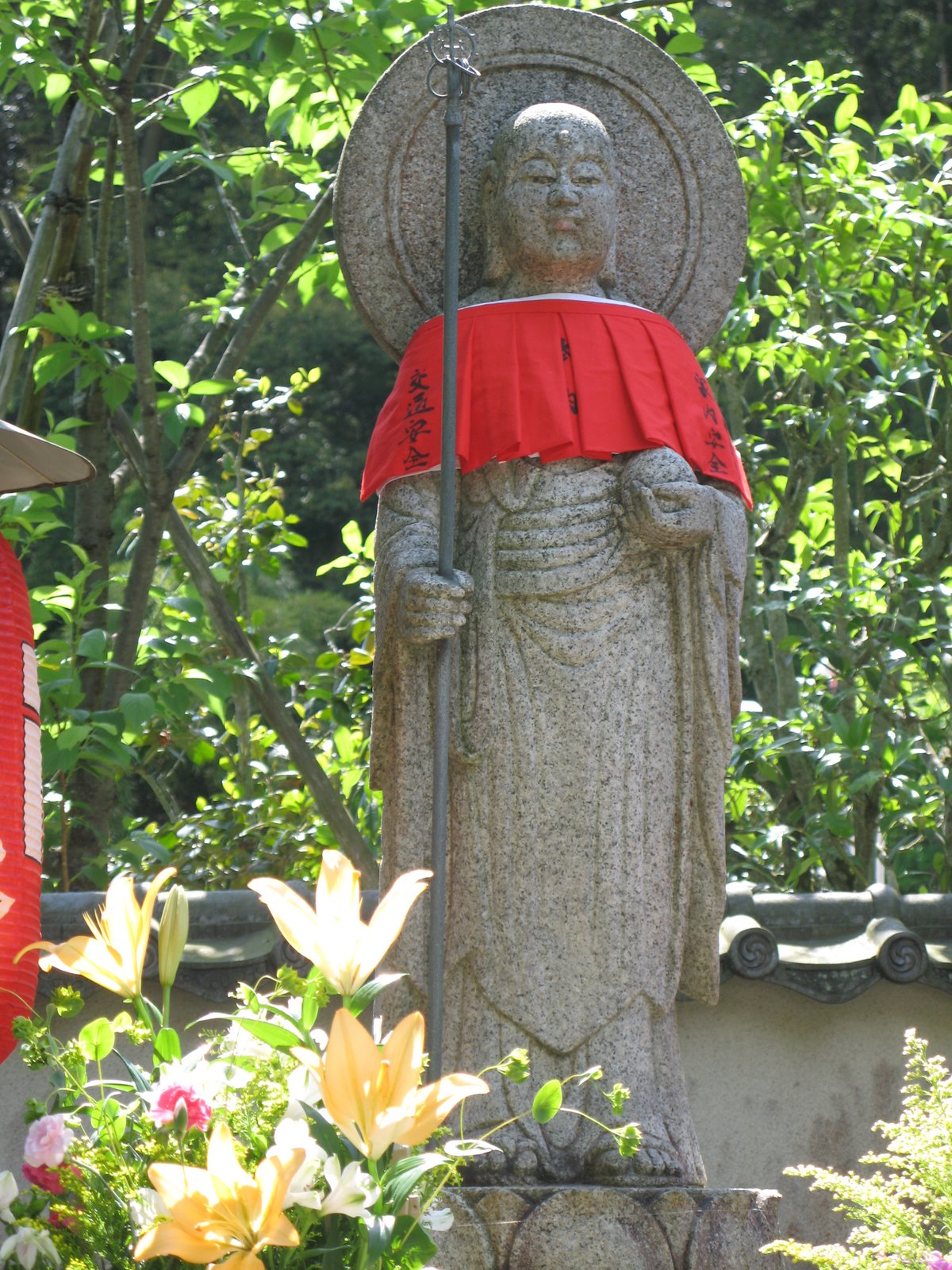
Jizo at Suzumushi Temple - Picture by Michael Lambe
Note: Jizo or Ojizosama is a kind of Buddhist
saint, considered to be the patron of children, particularly those who
die young. His statue can be seen everywhere in Japan, by the roadside,
in temples, shrines, up a mountain or in a forest. Often he is dressed
in a red bib or decorated with childrens’ toys to make his appearance
less fearsome to the spirits of the children he will guide into the
afterlife. More recently in Japan he has been worshipped as the guardian
of the souls of stillborn, miscarried or aborted fetuses. These are
known as 水子 “mizuko” or “children of water“.
You can see trailers for Roger’s previous body of filmwork on his website here: rowmusefilms.com.
Roger is also an accomplished musician. He writes his own soundtrack
music and performs regularly as a pianist with a shakuhachi player,
percussionist and trombone player. You can see some of his musical work
here: shakuhachipiano."
Most Japanese women, built as slim as they are, don't have much in the hip department. But that doesn't prevent some of them from affecting a wiggle in their walk that would make Marilyn Monroe blush. Today, I saw one such woman, walking with such a contrived shake that it seemed as she was trying to dust the sidewalk with her skirt. In fact, the whole thing was lopsided, the shift to the left far more pronounced than to the right. Her butt would literally pull her off line, her right leg then stepping diagonally back to center. If not for this correction, I feared that in about 15 steps or so, she'd wind up in the street and get hit by a taxi.
On the turntable: Santana, "Lotus Gem"
On the nighttable: Ivan Morris, "The World of the Shining Prince"
Everybody on the train looked exhausted. Granted it was a summertime Friday, but it wasn't yet nine in the morning. Even the school kids, off to some sports event, had their bodies slumped onto one another, a far cry from their frenzied ass-grabbing antics that usually annoys the rest of the commuters. With the grated metal window blinds, the Hankyu car looked like it was transporting cattle.
Miki and I both found ourselves with a rare weekday off, the perfect opportunity to finish the Western end of the TSH. We were pretty careless this time around, no checking of bus schedules as usual, and thus found ourselves stuck for 45 minutes in a bland bedroom town, trying to keep at bay both the heat and the accompanying grumpiness. We finally made it out to the base of Ryuōzan just before lunchtime. Depsite the lighter packs, our legs were still carrying the weight of last week. We walked silently along the trail, through a dead landscape of downed trees, corrogated iron rice fields, and wood shards littering the trail. Yep, we were back in Kansai. Machine cluttered farms lined the trail, above perpetual signs of road work and the industrial metal clang coming from further out in the hills. It was as if the world was a film set being constructed. Passing through a heavy anti-boar gate, we came to a small pond whose surface was nearly covered by lilipads. They formed a triangle not too dissimilar than the shape of our rice balls, bisected by the slight trace of where a duck had recently swum across. A beautiful blue bird perched on a low branch, then had a brief pre-lunch dip.
We found a hamlet next, where an old farmwoman snoozed in the shade and a lizard fell from a sheer stone wall with a 'smack!' A small white truck was parked along the next forest road, with more loud banging just beyond. Intending to gather police evidence, I took a photo of the license plate, switched my camera to video, in order to shoot these men as they dumped their trash. To my surprise, the racket they were making was them instead cleaning the forest. Beyond them, middle-aged couples were filling jugs with water spilling from a forest spring. Here the trail gave us our only climb of the day, which seemed to annoy our calves until they were appeased by the level ridge that followed. It was a straight and narrow path, past massive cemeteries and the odd stones marking bigger, more important men. (Are we truly equal after death?) The trail dropped past a large granite TSH marker sitting before a nature center. And here we lost the trail for the first time. There were quite a few paths with different names, which has been our curse since entering Osaka-fu. We chose the one that seemed to match our guide book, following it up a hill until we saw a sign that pointed back the way we'd come, reading, "Start of Tokai Shizen Hōdō, 0.5 km."
S-say what?
Apparently we'd finished about 2 minutes before at that big grey stone. It was the perfectly ironic way to finish, missing the marker as we had done dozens of times before. But it was a major letdown. After 431 km, over 12 months, there were no hugs, no high fives, no moments of relieved smug satisfaction. Instead, we'd marked the occasion with our all too familiar, where the hell is the trail? It is only in my role as a yoga teacher that I can appreciate the perfection here. How often are we focussed on reaching a goal, getting far more caught up in the idea of finishing than in the appreciation of the process. Just this morning, Miki had said she would've been fine not to complete this walk, and she wondered why I'm so attached to my desire to finish. I wonder that too, actually. Today's walk in particular felt spurred on toward its completion, rather than enjoyed. How poetic then, that when we finished, we weren't actually there.
Profoundly disappointed, we moved along toward Minō Waterfall like a couple of deflated balloons. There we stood in the spray, feeling it on our faces, arms out in supplication...
On the turntable: Chet Baker Trio, "The Touch of your Lips"
Nine merciful hours of sleep later, we were in front of the train station waiting for a bus. Behind us was the tall statue of Basho. For a man who specialized in the subtle, there was nothing subtle in the scale. It seemed less for the haiku poet and more for the Tokugawa spy he may have been. (How else to explain his freedom of movement?) On the bus ride out of town, we passed a foreign woman on a bike. I lived long enough in the country to know that foreigners in small towns like this are almost tourist attractions in their own rite. 'The Iga Gaijin.' I tried not to think what might be in store for us today. Each of these three days had proved to have it's own challenges. The first day's were topographical, going over three peaks higher than 800 meters. (In fact, I later found that we'd essentially gone over what's known as the Muroji mountain range, a chain of six peaks above 700 meters, though mercifully we probably never dropped below 400.) The second day's were man-made, with the stairs and the bizarre choice of route. Today's will be atmospheric. As we sat out the electrical storm at the onsen, I noticed the darkest, nastiest clouds were over the valley we'd walk. This morning, the valley was still engulfed in cloud. Miki petitioned the sky gods as we trudged toward the temple again. Behind the main hall is a massive figure of Fudo-myo, his right eye twisted with his grimace. Incredibly, we'd met four people with a similar looking lazy eye, all within 30 minutes, including this temple's priest and wife (and their dog, but he didn't count.) I think of course of a limited gene pool, this village surrounded by mountains and cut off from the outside for centuries. This also explains the unfriendly way we were received. Our friendly calls of good morning continually going unreturned.
But we weren't thinking this as we moved over rough stone slippery with rain. Atop this rise was a small shrine. (My tally for this stretch of the TSH is two temples, two small shrines, and a single jizo. Due to the lack of such markers, I'd speculate that this area had been settled late, sometime in Edo perhaps.) The trail dropped straight down to the valley where the onsen is. I didn't even look in that direction. I was quite frustrated about how the outdoors has become a commodity, a place to which you drive and pay too much money in order to 'enjoy the nature.' People who want to have more of a pure communion are being priced out. Here in the forest was the real thing. We crossed a dozen streams, each flowing fast, then climbed into the foggy cedar groves, rich and sweet smelling from the damp. A yelp that we thought was a deer belonged instead to a dachshund being walked by it's owner. This was a sign that civilization was nearby, and we found it in a Youth Camp beside a large lake. We sat atop a grassy berm and had a late snack, before tackling the final climb up the spookily named Reizan, "Spirit Mountain." We had lunch beside a mound with a small Buddha inside, marking the former sight of a Tendai temple. Miki chose to lay back onto a large pile of deer dung, while I watched the trees exhale steam.
Then the knee surgeons were back, forcing us to descend five km down a 45 degree stretch of road. I can't remember how often we slipped, my mind too taken with the pain in knees and calves. Two hours later, the trail leveled off. We desperately wanted to sit and rest, but could hardly find forest floor due to all the rubbish strewn here. Welcome to beautiful Tsuge. As further insult, just inside town, the trail markers disappeared. And the rain, which had teased us all day, looked ready to up the ante. We were within a kilometer of the station, but didn't know which direction. We probably covered three times that distance until we figured it out. Exhausted and in pain, we walked silently, but for the sound of our final footfalls on the Yamanobe section of the TSH.
In our local sento back in Kyoto, I thought how well we'd done, aches aside. To date, we'd covered the furthest distances, along a stretch of the highest ground, over the longest number of hours, with the greatest amount of weight on our backs. All without a map.
On the turntable: Herbie Nichols, "Complete Blue Note Recordings"
We moved quite slowly the next morning, downing canned coffee and showering with a hose.
At six-thirty we started up the fire road where we'd spend most of the morning. Six km later we arrived at the campsite where we'd expected to stay, had yesterday's trail been more cooperative. The vegetation here revealed that we were once again moving toward Kansai. We passed through a community of posh 'second homes' where the vending machines charged 160 yen from a can of tea and the toilets were off limits, then pushed on up to Aoyama Kogen which was flat and open, revealing what we'd spent a day and a half walking over. Ise Bay stretched away to the east. We talked with a man who was gearing up to climb the Chuo Alps this summer. This view was also popular with the motorcyclists who'd ride up, have a smoke, then move along the road to the next view. The map up here showed us five more rest stops in the next 10km. Little did we know that we'd be instead walking the ridge below them, along overgrown trails which forced me to hunch over. The forest here was very active, most of that life airborne. I kept knocking cicadas off branches with my bag, and they'd smack into one of my temples, or both. Worst were those that tried to climb into my ears, their screams like the worst speed metal distortion. It's a wonder I didn't have tinnitus at the end of the day. But worse yet were the trail planners. This stretch was a roller coaster, up and down, up and down, over those stairs that I've come to loathe. There is no apparent benefit that I can see to putting a body through this. A path running parallel to the road would've been fine. Perhaps it was a conspiracy involving local orthopedic knee surgeons. There were some bigger animals up here, deer and rabbits dashing startled through the brush. The ridge was lined by tall windmills, their blades slashing through the air with a roar that caused the whole forest to throb. At the end of the row was a windmill commemorative rest stop with typical self-congratulatory display. "Look what we're doing to the Earth!" It must be the only tourist place in Japan that doesn't have a vending machine, which was sorely missed on this hot day. The reason could be related to their 'eco-conscious' themed signs, but how to explain the sensor-activated electric doors?
The trail now was a gentle ascent through a beautiful stretch of forest. Why ruin it then with the highest, steepest flight of steps leading back up to 800 meters? Erosion made most of them rise from the ground like goal posts, and gravity brought many of them vertical, becoming more ladder than stair. (Later, I noticed that our TSH blogger called then "Hell's Staircase.") I moved toward them laughing, singing Tom Waits' "Straight to the Top" until I was too winded. Then Waits' "Step Right Up" became more apropos. At the top of Kasatoriyama, we met road which descended as a steep concrete strip toward the village of Oyamada. There were quite a few Buna trees up here, a species I'm beginning to much admire. They are the rebels of the Japanese tree world, following their bliss amidst the monotonous straightlaced cedars. I lost interest in them too eventually, as my legs complained about the angle of the slope. I didn't know my knees and calves knew such foul language. I was so far gone that I forgot to be startled by the viper that I nearly stepped on. It was young and cocky, moving toward a rock wall, then turning to look back and mock us, like saying, "I could've had you if I'd wanted." Which begs the question: Do poisonous snakes know they're deadly? If so, how do they figure it out?
We reached the village proper now and sat beside an abandoned shack to the delight of our legs. There was a river beside us, which, if you believe the signs, is teeming with those rare Giant Salamanders. We crossed the bridge to a sake shop to ask the proprietess about lodging. I'm constantly amazed how local people can give so much information while simultaneously giving so little. This talent cuts across cultures. After her 10 minute zen koan, we moved on to Daibutsuji, where we'd start the following day's hike. There was an information center here, with a small folk museum upstairs. These are always interesting. We poked around, then melted into chairs to drink the tea a woman served us. Her answers to our lodging questions gave us a few more options, but most of them she couldn't answer. We left our bags and went next door to the temple to have a look. This was the first real living temple of the trip and should've held our interest. But we'd done back to back 30km days over tough ground. Last night, we'd agreed that it had been the hardest single day hiking for us, but today definitely prevailed.
We'd puzzled out that there was an onsen nearby that did food and may have camping out back. We thumbed a ride, from a jimbe clad guy in his 60s whose taste in cars and music was that of a man half his age. At the onsen, we weren't impressed by the surly staff, and less so with the 4500 price tag for a tent site. We hemmed and hawwed awhile before fatigue prevailed. Just as we stepped outside, the skies tore open. Sigh. We sat licking ice cream with Charlie Brown black clouds around our heads. Other guests sat waiting the storm out. After a short while it dawned on me how big a hit my genetic makeup was making with the locals. Inspired, I went back to the counter, told them what they could do with their overpriced square of dirt, grabbed the grottiest, most abandoned-looking umbrella in the rack, then stood out in the rain to hitch a ride...somewhere. Now let me take a moment to say how incredible a woman my wife is. No matter how long or hard the walk, she never complains. I could practically see her twitching with anticipation for a hot bath and bowl of warm noodles, but still she didn't moan. After a couple of minutes she was beside me, thumb out. Carload and after carload of pampered, happily relaxed day-trippers drove by our sorry, sopping, sagging selves. But Miki was a trooper. Finally, as dark was nearly complete and our hopes were almost gone, a pair of heroes picked us up and drove us the half hour to Iga Ueno. As long as I'm doling out kudos, I shouldn't forget the person who decided that it's imperative that the Yoronotaki izakaya chain have such wonderfully big draft beers. Nor the person who designed the lengthy tubs in Green Hotels. I lay there, my calves blown up like balloons and heavy as lead, the song of cicada still echoing in my ears...
On the turntable: "Hare Krishna Hare Rama"
On the nighttable: Henry Scott Stokes, "The Life and Death of Yukio Mishima"
Miki and I wanted to escape Kyoto's Gion Matsuri like the plague. We still had to finish the Yama-no-be section of the TSH. For whatever reason, our guidebook neglected to cover this section, and the usual TSH bloggers had little to say either. One guy did it over four 6-hour days, but he proves to be a powerhouse, clocking times much quicker than ours. We reckoned that if we carried camping gear, we could do it in three long days. The additional weight would slow us down of course, but it would be good practice for the six week walk we have planned for later this summer.
On the Japanese national holiday commemorating the sea, we once again headed to the mountains. We spent Friday night in Nabari, in one of those small seedy hotels that blurs the line between business- and love-hotel. A cheap dinner in a locals only izakaya fuelled us for an early start the next morning. The bus had us at the trail head before nine. A month before, we stood in the same place, admiring this same view. But this day was to teach me that those same mountains whose shapes you most admire tend to bring the most grief. A sudden ascent led us quickly through a village and into a forest where we soon became lost. The path here is well marked, but a typhoon had caused some heavy damage to the region, sections of the hills shoved violently down into the streams below. The path took some unusual twists and turns, no doubt created by the footfalls of hikers winging it. We found ourselves looking up at the remnants of a slide. After poking around looking for alternative routes we decide to push straight up the slide, happy to find the actually trail just above. We soon came to a parking area, where a frog-like granny sold unseasonably warm drinks. I wanted something cold, but her cute expressive face nearly made me cave. Just above this lot was the Soni Kogen, a wide grassy plateau that rose up toward three peaks. A marshy lake filled the basin between and beyond it, we could see small figures pushing their way slowly up a long, straight diagonal toward the 800 meter pass. For some reason, my mind flashed onto a famous eight minute long take from Wender's "Wrong Move," where his characters riff about life while ascending toward similar heights. The climb was quicker than expected, through grass moving in waves toward the col. Other figures were higher up on the peaks themselves. Our own route brought a merciful descent, into a well tended forest, and eventually to farmland well fortified against hungry wild critters. We passed a woodcutter with a machine slung over his shoulder in a way similar to Mifune's wanna-be samurai slung his in Kurosawa's classic. A bearded artist-type was weeding amongst his chickens and goats. One kind old gentleman offered us a ride. The other villagers we passed were equally nice and friendly, but one disturbing thing about the place was that the trail signs had been altered to point toward a single destination; some kind of herb garden for tourists. We really need those markers as we didn't have a map. Mie performed as well as expected, offering not only well-marked trails but also the occasional map. We sat beside one of these, eating lunch in the shade of a sake shop. The map showed that we'd be spending the afternoon going over two 900 meter peaks and both Miki and I seemed to dawdle over our food, not wanted to face the inevitable.
We eventually moved on toward Ōborayama. Halfway up the mountain we passed the only temple we'd see in two days. Beyond it was a field of bizarre rock shapes. Apparently this whole mountain was supposedly the body of Zao Gongen, the deity so beloved to the yamabushi. And typically, spiritual peaks are in the best shape. The forest up here was lively, frogs jumping all about, doing extreme leaps off the trail and free-falling out into open space below. I saw more than one bounce headfirst off trees or rocks, wondering each time if their joints and heads were as elastic and squishy as they look. And the higher we climbed, the bigger the frogs were. Long legged spiders moved out from beneath our feet, their extreme appendages looking like sci-fi moon landers. Most bizarre were the crabs that never fail to surprise me when I see them at these heights, near no water whatsoever. We moved below the peak and came to a stone trail that paved the ridge. The stones were weathered and uneven and slowed our pace a great deal. There was no surety to our steps due to many of the stones rolling if trod upon. Another slide forced us to drop far below the ridge, then rapidly up again. We came across more and more of these rapid ascents, striated by those helpful 'log' steps that are a boon to hikers everywhere. New they might serve a purpose, but years of erosion turns them into hurdles, the hiker then forced to goosestep over them. Killer on the knees. Up until now I'd been thankful how Mie had kept the trails well-marked and clean, but now it seemed excessive.
We soon came to Amagatake. Whereas the former mountain had been green and teeming with life, this mountain was the land of the dead. The flora? Cedars. Fauna? Cicadas. We moved along the bare forest floor devoid of anything but dirt. More of those deadly steps strained our knees as we moved up and down the hills. The descents were most fearful, the logs shifting with our weight. My footing wasn't sure yet, my center of gravity uncertain under the heavy pack. As we moved downward, we saw a sign that promised a short cut that would save us nearly a kilometer of walking. Instead we walked nearly three times that as we moved the wrong way along a road. Miraculously, a car came from nowhere and the driver set us straight. No more short cuts.
Around six-thirty, we finally came to Menard, a posh resort for golf and tennis and overpriced food that sprawls across the hills. We stocked up on water, then found a nice patch of grass at the resort's far end. As we were illegally camped, I won't reveal exactly where, but we had toilets, a vending machine, and BBQ pits. We had dinner near the latter, as stars came out and fireflies flew by, bigger and much faster than their citified cousins. We waited until after dark to set up the tent and settled down for a restless sleep. Resort workers came and went from a building not far away, every voice bringing anxiety about being caught. The cicada had quieted down considerably after the sun fell, but their occasion soft buzz sounded too much like the footfall of large predators, bringing me quickly back to alertness. A couple of deer had a conversation down where I'd hung my sweat-soaked clothes. I pictured them having a feast at this newest salt-lick, and my shreaded clothes strewn about the next morning. And then there was the genius who parked nearby, turning his car stereo up to 11, and blasting some asinine talk radio from 4 to 4:30. Thanks dude...
On the turntable: "Putumayo Presents Acoustic Africa"
On the reel table: "Omohide Poroporo" (Takahata, 1991)
"Etymologically speaking, a breath is not neutral or bland--it's cooked air; we live in a constant simmering. There is a furnace in our cells, and when we breathe we pass the world through our bodies, brew it lightly, and turn it loose again, gently altered for having known us."
Here is something I wrote last winter. It started life out as part two of this post, yet I'd hoped it would grow up into something bigger. But life, and the mind, moves on. Come here and speak my dear foundling...
...so I walked. It's good to walk. I once loved to walk the streets of a city, any city, in order to see a place without the plastic. When dusk falls, the cities facade--as presented by City Hall and the Chamber of Commerce--crumbles. Only real people exist after dark. I traced unlit streets, figures moving toward me, literally lurching with the pull of a briefcase to one side. Taxis shot by on these narrow paths, slaloming the figures, the telephone poles, and me. Near the top of the street a dozen women are huddled in the doorway of a woman's shelter, waiting for it to open and looking very cold. Despite being very well dressed, they could be extras in some Depression era film. The lights of Shijo well up and I move along its covered sidewalks, in front of Xmas trees and winter coats behind glass. Here are more young, well-dressed women, striding quickly toward home after work. I dogleg up Teramachi, following the covered streets in order to stay out of the rain. It's more crowded in here, young dudes with big hair lurking around, squatting in front of closed up shops. A few have their guitars out, each song always in the same pitch, the monotone caterwaul always loud and sincere. Oike-dori is busy and bright , the neon blue of the fountains mocks the water that flowed here in better times. I drop into the subway, encountering now the couples, many heading home as it's a worknight. As if in opposition, the solo subterranean figures look lost, ruffled hair, faces hiding behind books.
Through all this I have the new Dylan on the Pod. His latest is a greatest hits collection, each track having once played soundtrack to my previous walks spread over various countries. The words are universal, international, interversal, descriptions of characters like those I pass on this night. Dylan remains ever the griot, stripping bare the same facades that daylight encourages. And with these truths I slip into a certain state, one step closer to the reality of the beings with whom I know nothing except for that they are right here. I could break the wall even further by making conversation, but that moves the truths from the universal to the personal. I prefer to keep things general tonight.
This illumination is blinding upon entering a bar. There are many people there, but there is nobody there. Aside from one friend, everyone is new to me. Where did they all come from? I'm feeling too separated, too happy in my own protective zone of the general, to connect. The darkness here helps, as does the smoke from the fireplace now filling the room. I chat, I joke, but I give nothing. I am enjoying the company of these people who I've never met, hearing their stories, but I deflect any questions. The only real necessary communication, ordering a beer, ironically leads to a situation even more disjunct, where the order never comes. I keep one eye on the window, watching the rain. When it lets up, I go.
I'm alone now, but for Dylan. His words follow me to the towering Sanmon gate of Nanzenji. Architecture of such size tends to diminish the personal. I stop awhile thinking of other nights I've sat here, yet these memories intermingle with memories brought on by familiar songs. I'm in many places, many times, many states of being, at once. The night feels heavier all of sudden. A city this old is full of ghosts. And they are here, mixing with my own ghosts. I begin to move toward home, through a night that becomes more the feel of autumn, with an increase in the wind. This wind swirls the leaves along the street, along which go my thoughts, constantly scattered, scattered.
It's July, I've got less than two months to go here in Kyoto. Lately, I've been peeling away my work and other obligations like sunburnt skin. Which frees up my Mondays. I decided to spend this one with JesusChris, meeting him for the first time since April. Hanging out with him is like hanging with Local Legend Tim, moving aimless through space as the day unravels toward night.
After an exuberant chat over a potent Vietnamese tea, we moved up to the compass atop Yoshida-yama. We cooled ourselves on the marble stone, talking and listening to a storm coming from the south. We moved over to the cemetery above Kurodani, watching high battleship-grey clouds mount their attack on Kyoto Station (as punishment for poor architectural accessorizing I suppose). The clouds began to flank our own position and the big fat drops began to fall, foreshadowing an imminent deluge. The skies opened just as we found shelter in front of a barracks-like apartment building. JesusChris immediately stripped off his shirt and shoes and bounded merrily into the rain, looking like he was starring in his own personal Bollywood musical. I stood dry under the tin roof and pouted. In most of my relationships with friends, I am the impetuous one, but here I stood, alternating mentally between excuses about why I wasn't out there and scolding myself for being so straight. And there I stayed, as my friend frolicked and danced and I merely hunched and stared stupidly at a security camera.
These squals rarely last long, and when the rain let up, we moved down toward Shinnyodo. But the storm regrouped and counterattacked, throwing large pyrotechnics our way. We huddled and had a Rashomon moment under a temple gate. Each time we'd step out, we'd get hit with another burst. Finally, as the skies showed blue and the grey had moved on, we started uphill. And one final, enormous, arm-hair raising flash hit the cemetery stones to our immediate right, the final thrash of the dragon's tail. I showed JesusChris Honen's purple cloud meditation stone, he in turn introduced me to Afro Jizo. Under the half-closed eyes of Oily Buddha, we parted ways.
The storm returned a couple more times before the sun set. In the fading light, the season's first cicada began to sing, like the tuning note of an solo instrument which serves as the seed of the symphony to come. After dark, the moon rose in our small valley, ducking and weaving through the clouds. The light from it's rays streaked the wet air, extending from all four cardinal points like a Zia. I knew that much later, in the middle of the night after the city went to sleep, my bedroom would take on that special glow of the full moon's light. I will miss that certain quality that the light takes during early these morning hours, and the feeling that I'm the only one in the world who is lucky enough to see it.
On the turntable: Skatalites, "Hi-Bop Ska"
On the nighttable: Diane Ackerman, "A Natural History of the Senses"
EzakiMitsuru was having another exhibition down at Gallery Mu-un. So it was that Miki and I, along with KJ John and Sage, spend a long morning making our way down to south Nara. There were a few of the usual Yoromi suspects around, including that couple from Fukui who do kamishibai. We passed the afternoon in conversation. It was interesting to see Ezaki's latest works, and how he is continually developing as an artist. He talked about the creative process behind his new fish hanga, and explained the multi-faceted Buddhist philosophy behind one of his earlier works, which up until now I'd taken for an eye chart.
As the conversation shifted toward other ears, the four of us walked through the village and up the hill to the swampy lake, then got lost in the forest on the way down. In the late afternoon John and Sage hopped a train north, to be replaced an hour later by Zach, who was in Kansai on business. He was pleased with the natural and healthy food to come, as he'd been holed up in a dormitory somewhere in the industrial bowels of Osaka and force fed starch and salt. This simple dinner had all the feel of a party, and although we'd arrived worried that we'd brought too much beer, as we staggered off through the dark toward our beds we found it had been just enough.
Dawn marked the curtain rise on a comedy about me noisily rattling a dozen doors in search of the toilet. Giving up, I walked over to Mu-un along a road damp with rain. I sat awhile and looked across the hills toward the bigger peaks draping their shoulders with white mist. It was a quiet morning, last night's revelers appearing one at a time as if making stage entrances.
After a late breakfast, Miki, Zach and I made our way to where we'd left the Hodo a few weeks before. We quickly came across a small shrine that pointed in the direction of Ise. A tiny green frog was balanced on a hollow piece of bamboo, and another was bathing in the rainwater within. Zach picked him up but he leapt away, launching a desperate kungfu kick in our direction as he fell. We followed a paved road around a lake. It was hot day, and below us, a few men under umbrellas had wonderful ringside seats for a good day for fishing. As we crossed a high suspension bridge we saw a school of large grey flat monsters moving toward the baited hooks. We kept along the road, falling into conversation when the scenery let us down. Which wasn't often. The striated lines above the water told the history of the lake and above, birds perched in trees waiting for lunch to swim by. Eventually the water stayed behind as we moved into the hills. After too many experiences of searching frantically for trail markers, we found one that was the size of a small house, pointing into the forest. Just inside, a car came rushing down the hill, chased by what I thought was a deer. On closer approach, it proved to be the biggest dog I've ever seen, probably a Mastiff-Great Dane mutt, out for a 'walk' with its master, running after his car doing at least 20kph. It looked pretty tired, but turned to flash a wet, sloppery smile as it passed.
We climbed up and over the pass, through a forest well used. There was a large sprawling park at the other side, then a village, then Muroji. We had time to kill until the bus, so spent it searching in vain for the ice cream we all craved. Shaved ice just wouldn't cut it. And so the bus came and took us to the train, and we moved west, toward the bigger and crowded cities where people understand that summer's value is measured in ice cream...
"The threat of extinction, be it to animals, languages, ways of life, human skills is a wake up call to cease believing someone else will solve the problem. The solution begins with rejecting the lack of diversity in one’s own life, of refusing to accept the small extinctions forced on us by an addiction to convenient living. The concern about extinction has a real effect if it encourages us to make our own lives less like everybody else’s. If it makes us more willing to seek out our real nutritional need for that sense of delight that comes from things being various."
On the turntable: Jimmy Smith, "Back at the Chicken Shack"
I just got home from Osaka, after a quick dinner at Cafe Absinthe, beneath the photos of some of the 100 famous Japanese peaks that Wes climbed during over a period of years. I was tired from teaching two physically challenging classes earlier in the day, the fatigue allying itself with the humidity to get me buzzed on a single pint of Guinness. I smiled as I walked to the front door, coming to a complete stop at the sight of Paris Hilton dining in front of the large open window. Her Russian was absolutely perfect.
With a nice light floaty head, I bounced along through Ame-mura, my first visit in many years to the place that was once a familiar haunt, back in those days when I first came to Japan and needed the occasional dose of Western Civ. I found Midosuji Dōri, and moved in the direction of Yodoyabashi and the train home. I walked the light of the day away, Tom Waits on myPod, admittedly better suited to the grubbier downtown areas that make up the bulk of my city hiking these days. Midosuji is all glass and glitter, boasting of an opulence that seems ridiculous considering the current state of the economy. This is not a street you walk if you're looking for perspective.
You'll see instead a church that is fronted by the pillars like some Wall Street place of worship, throwing shadows across a VW bug garlanded for faux weddings. Or another bank that brings to mind the lobby of NY's World Trade Center, so long as you excise the Excelsior Coffee shop next door.. Or Namba Temple done up in the finest of Soviet architecture, like some double-zentendre ironic protest. Or high-heeled fashionistas who resemble the store front models far less than I do (Though we were all trumped by that middle-aged woman done up like a frilly southern belle.) Or the short-sleeved Cool Biz commuter troglobtyes moving toward their trains. Most intriguing was the guy who awoke after the train doors closed, stood when the seats automatically shifted to the reverse side for the return journey, then sat again to ride back the way he'd come. I speculate on his passing an entire day this way, riding the train the hour it takes to go end to end, nine times a day, hiding from his family the fact that his job is long gone.
On the turntable: Tom Waits, "Spare Parts"
On the nighttable: Ian Littlewood, "The Idea of Japan"
On the reel table: "Porco Rosso," (Miyazaki, 1992)
The duck raised its body out of the water, flapping its wings madly as if trying to life the river from its bed. Then it settled its body back into the water. A neighboring bird repeated this process, followed soon by another, as if collectively, they could reclaim this river that bears their name.
On the turntable: Eric Clapton, "Orchestra Night"
On the nighttable: William Zinsser, ed. "They Went"
The day after the Katsuragi walk, I found myself on a train heading back down that way. Miki and I plan to do the next section of the TSH in a few weeks, and we'd start today from Murōji and cross the mountains into Mie-ken. From the station, we faced a 90 minute wait for a bus, but were able to thumb a ride with a kind woman thankfully heading into the mountains. Miki and I wandered in circles awhile around the souvenir shops, trying to decide whether or not to eat some yomogi before setting out. The owner of the shop settled it for us by not being there.
A short walk up the road was Ryuketsu Jinja. It was a simple, beautiful structure fading into the forest beneath massive cyprus trees. These blocked the sunlight so effectively that the shrine was nearly lost in the dark but for the lanterns that hung from the eaves. We sat here awhile, eating lunch and trying to ignore the occasional outbursts and laughter from a trio of middle-aged motorcyclists jabbering away out on the main road. As if in contrast, a half dozen women were standing behind the shrine, chanting the Heart Sutra repeatedly for the entire half hour that we were there. This shrine is where you come to petition the God of Rain, though I doubt the women's effort was worth it this close to rainy season. But they played their part well, dressed in the garb of the pilgrim, much like the guys out front played theirs, wearing clothes that screamed, "Sunday Biker."
We walked up the highway, past a luxury car with Fukuoka plates, and a man who had absolutely no life in his eyes. Leaving the main road, we climbed up toward the cave where a dragon was said to dwell, giving name to the shrine below. Along the way, we came across a hole in the earth between two huge stones. This was supposedly the lair of Amaterasu, who, if you believe the talk of local shrines around the country, has spent the night in more places than Wilt Chamberlain. Moving up the hill again, we were nearly mowed down by a car driven dangerously fast by our friend with the lifeless eyes. (These snake/dragon shrines tend to attract some bizarre and frightening people.) And there was the cave, up a river gorge fed by a waterfall. It was framed with a shimenawa, hung by some brave soul immune to the laws of gravity. It was an inspiring sight, this immense cut in the rock wall, above a fast and powerful river.
We dropped back to the main road, following the wide river fed by the dragon's gorge. Above it were a series of rice fields, and the frogs singing merrily within. I've been lucky to have spent nearly every weekend since March out in the country, and it had been wonderful to experience the spring as it has unfolded. I've been able to listen to the song of the frogs change as it has matured from the creaking and popping of tadpoles in April, into this throaty self-sure song of summer. It was a similar story with the birds. The nightingale was still the prominent diva, having honed it's skills over the past two months. But a few newer voices were now beginning to push their way onto the stage.
They were all in full aria as we moved along a logging road that petered off into forest. The track now became cobblestone, slippery with the covering of soft pine needles. It got steep quickly, shadowing a river that dropped away repeatedly into unseen waterfalls. One spot in the forest was thick with the smell of dank mold. This odor was thickest around an old collapsed house here in the middle of nowhere. I worried about what may be rotting beneath.
Over the pass we met road again. Sudden movement between my feet proved to be a snake that shot quickly into the high grass. A short while after, I stopped to push a large stone with my foot into the river below. Watching it drop, I noticed an enormous black snake the size of a house cat, sunning itself in the hanging tangle of brush a meter from my shoe. (And I officially amend my statement that yesterday's snake was the biggest I've ever seen in Japan.)
Before long, the road dropped onto trail again, following a series of waterfalls that dropped like a staircase into magnificent swimming holes. At their base was Soni village, whose lucky residents got not only these pools, but a stunning panorama of peaks that ring the valley. The most impressive was Yoroi Yama, looking like Devil's Tower with hair implants. This area was an outdoorsman's paradise, the campground containing a heated toilet for those "roughing it." A fish farm kept the local streams well stocked with dinner. The water of the pond beyond them was far less clean, the surface thick with unbroken green like this country's famous tea. We walked happily through the village, feeling that at last, it is summer. Atop the rise was a temple built like a farmhouse, and below it, some firemen were climbing into an old and tiny firetruck. A small boy seemed more amazed by the sight of me than the fact that he got to ride in the open back of such an awesome machine.
Arriving at the main highway, I felt something in my shirt, and reaching in, I startled a bee into stinging my chest just above my heart. I'm not allergic to bees, but I'd never been stung in Japan before. I tried not to think about it as the pain began to kick in, instead focussing on hunting and gathering a lift to Nabari Station. We got a ride pretty quick, our luck better than the driver, who had been unsuccessful at fishing in some of the incredible water we'd been walking alongside through the afternoon.
The weather report throughout the week had proved schizophrenic, but the clouds Saturday seemed encouraging. So it was that I met up with Ojisan Jake and Aurelio for the long ride down south to Gojo where we'd start walking the KatsuragiKaidō. I'd long been interested in this walk, as this was reportedly the birthplace of En-no-Gyoja, the legendary founder of Shugendo.
The first traces of history we found were from much later, in the form of a well-preserved Edo period residence of the Fujioka family. The painted fusuma within were well kept, including one room that had a wrap-around view of Lake Biwa. Nearby was GoryōJinja, whose grounds seemed much younger than the buildings it contained. The paint on the main shrine was well-faded but hinted at images previously bright and alive with color. It reminded me somewhat of the temples of Korea, no real surprise since this region was the traditional home of the Kamo artisans who'd settled here during Japan's early history. I tried to ask the caretaker about this history, but he'd proven surly and unwilling to talk. ( In hindsight, I feel somewhat guilty about interrupting his sweeping, and certainly hope I didn't make him lose his place.)
We moved into out into country, between rice fields late in their flooding. Tractor tire marks looked like kanji traced in the soft muddy beds. A couple of old-timers were just putting the rice shoots in, as one young boy ran about catching frogs. He placed a small one in a bucket beside a massive bullfrog staring off into space and no doubt wondering how he'd gotten into this predicament. The younger of the two old men told us how after the war, they'd often eaten these giant frogs, and they were tasty when prepared with certain herbs. His older friend, toothless and wearing a hearing aide, merely repeated a single question, four or five times saying, "I'll bet you've never seen such a thing, have you?"
We continued along the ambiguously marked trail, inadvertently exploring a few side roads in the process. When even the postman couldn't help us, we bushwhacked along a berm, arriving at the highway below, where some police where hoisting a broke down truck onto a wrecker. We found the true KatsuragiKaidō now, which led us to TakagamoJinja and a lunch break. Jake shared some of his homegrown potatoes, along with bread he'd baked. I swapped some of my trailmix. Aurelio seemed happy with his corn on the cob. We sat beneath the eaves of a resthouse, talking about revisionist Shinto and the Kojiki, until a couple of rather persistent bees encouraged us to get on with our walk.
The rest of the day we quietly explored the shrines and temples, and talked through the spaces between, alternating between discussions about folk religion and teasing Aurelio about his dislike of mariachis and Mexican food. We climbed up a road past the corpse of a viper cooking in the sun that was now beginning to come out. Atop this rise was TakamahikoJinja, looking old and magical with its tree-lined approach and the play of light in the valley above. Our map showed the curiously named "Ground Spider's Nest," which was a reference to the NihonShoki story of the powerful and long-legged tribe who'd given the early Yamato settlers a good fight. My brain was awash with Tolkienesque imagery as we entered the forest down a cobbled path, startling the longest snake I've ever seen in Japan. We missed the site at first, surprised to see a bicycle at the middle of a long flight of steps. We then back-tracked to find what we'd been seeking; a handful of stones and graves marking where the ground spiders had been defeated, in this grove of high grass beneath big trees.
We meandered down to a small Shingon temple (all the temples around here were Shingon, hinting at the Shugendo connection). An old woman worked her veggie garden, beside two sleeping cats tied to the rail of a small bell-tower. A mother and her child were in the well-groomed open space below, which was marked with a lotus and the words, "Meditation garden." It was peaceful to sit here awhile, but the day was getting away from us. We moved down through the forest then followed the Kaido through a series of interlinked villages. They in turn seeped into the towns further down, which stretched away to become a semi-urban cluster. One of these villages, Nagara, still preserved an Edo feel, despite the best efforts of a few pre-fab homes. The telephone office at the far end was pure Meiji, the wood faded to a grey that was nearly turquoise, the lettering on the windows thick and tactile.
We moved toward the mountains again, up to Hitokotonushi Shrine. You were supposed to make your request to the gods using a single word. The ema hanging about bore the character, "Nagau." Please. At this late hour, we saw only one other person, who spent at least 10 minutes bowing before the shrine. Either he was a Shinto linguist reformist, or he was in the midst of pronouncing the longest word known to human language. We left behind both him and the high peak of Kongozan, which had been above us through the day. Its sibling, Mount Katsuragi, rose above our left shoulders and took the sun from our faces. We decided to call it a day at Kuhonji, where a friendly priest was welcoming a few dozen kids to a session of zazen. We wandered above them to a countless number of Jizo spread out among a half-dozen groves along the mountainside. In the fading light there was a sense of peace up here, sharing the quiet with multiple generations of the village's dead.
It was near dark as we made our way down, past a some guys breaking glass and throwing loads of trash on a fire. The last bus was hours gone, and as I called a cab, there was a flash and a boom, as these geniuses got a first hand lesson in combustibility. I looked above them toward the peaks outlined by the lights of Osaka behind. I'd come here to Katsuragi looking for traces of En-no-Gyoja, but it was up there that I'd find them, up above the meditation gardens and tethered cats and painted screens. Where things no longer needed were not incinerated by a fire in a drum, but were instead purged by the internal heat of tantra.
(Jake posted some photos of the walk here. More to follow...)
On the turntable: Herbie Hancock, "Maiden Voyage"
On the nighttable: Alan Booth, "The Roads to Sata"