Showing posts with label Inland Sea. Show all posts

Wednesday, November 09, 2022

Knowing Tranquility XXV (Momoshima)


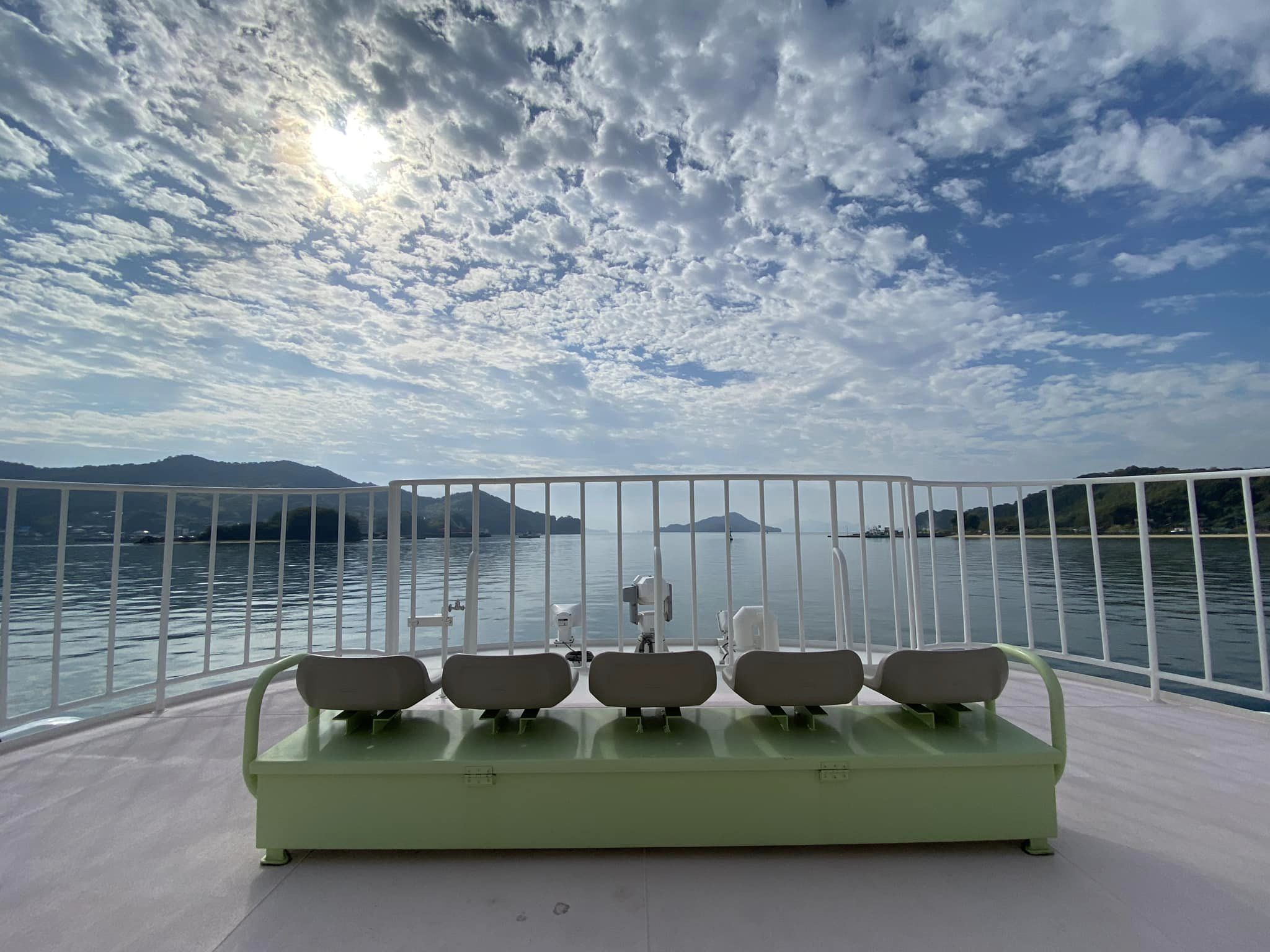
The sea reflected silver under herringbone skies.  The ferry drifted along the colorful wooden houses that lined the shore and past the stone Ozu lantern, before picking up speed once beyond the Onomichi Bridge towering above.  We were essentially traveling in the wake of yesterday's high speed trip, but I was solo this time, my two companions have left on a morning train.  I stood alone on the bow, face into a wind so high that I removed my sunglasses for fear of them being torn from my face.  

Seen from above, the figures standing on the dock at Momoshima were spaced in a way that made them look like they were posing for an album cover.  I had nearly three hours until my scheduled rendezvous with the people from the island's Art Base, so decided to buy my return ticket.  I caught up with elderly the ticket taker as she made her way back to the village proper, and as she counted out my change I noted that her eyes were a deep blue.  My daughter's mother, also an island girl, had mentioned that her own grandfather had eyes of a similar shade.  I pondered ancient seafaring foreigners who may have spent time sheltering from storms on these islands, adding in a night of passion their own personal stamp on the genetic makeup of the inhabitants.  

I headed inland to explore, aiming for a dotted line on a map that might have indicated a trailhead up to the site of the old castle that had once overlooked the harbor.  Momoshima had an interesting geography in having a central inland indentation ringed by hills, that undoubtedly offered ample protection from typhoons.  It helped explain why there were so few houses near the harbor itself.  There was no rice cultivation here, but plenty of vegetable plots.  

I wandered up through the quiet grounds of a small shrine tucked against a grove of bamboo.  Below me was the long abandoned school that was the now home to the Art Base.  I wound down and around the foot of the mountain but couldn't find a feeder route anywhere.  The most likely road dead-ended suddenly, home now to a pair of decades old vehicles rusting themselves out of existence beneath the bamboo.  I probably could have bushwhacked, but these thickets belied the existence of vipers who thrive in their shadowy corners.  

I instead returned to the bowl-like valley, not a soul in sight.  The homes were old but definitely lived in, the post office that served them shaped like the straw hats of the festival dancers of Shikoku just across the water.  The Art Base had a small mushroom farm beside the water, but there was no one here either.  So I wandered back to the harbor to read awhile.  

This too was void of activity but for a young man preparing to open a coffee shop.  The adjacent lot had a small trailer/kiosk Beer Bar that did drinks and food, plus a few chairs scattered across the lawn.  As the young man was telling me that he wouldn't be set up for a while, I noted a poster for a glamping site at the island's extreme west end.  The walk there and back provided the perfect diversion.

A family of bicyclists passed me as I moved past fields of weeds topped with little yellow christmas trees.  One plot looked post apocalyptic as it engulfed a long beached boat and a towering crane whose rust combined with the weeds below provided a sort of foretaste of the hues the maples would do in a couple month's time.  I traced the shoreline to a small peninsula upon which new guest houses were sprouting up like mushrooms.  Though varying in look, their uniform theme hinted at a common owner, who had a created pretty remarkable chill-out space indeed, with long wide-decks, cozy chairs, and every-ready BBQ grills, all reflected in large windows facing the sea.  

I backtracked to the glamping grounds.  Beside the yurts and tent sites was a small cafe, and I called out an order of iced coffee to the young couple running the place.  They joined me out on the deck out front, where I alternated between chatting with them and dipping into Alex Kerr's book on the Heart Sutra when they were pulled away by one duty or another.  All the while, the sea quietly lapped the sand of a small stretch of beach not far beyond my toes.  


The noon ferry rolled into the harbor, but there was no one there to meet it.  As I waited around, I thought about how these guided visits were only on the Japanese page of the Art Base website. Non-Japanese speakers would have no idea they even existed. A policy far different from the usual open nature to the organizers on other islands.  Granted they were independent and not affiliated with Benessee, but this soft racism left me with mixed feelings.  I suppose it was one way to protect themselves from the onslaught experienced at other sites during this decade of overtourism.    

Having been given no real instructions in any language, I backtracked to the Art Base, met the organizers, and settled into lunch.  We were allowed 90 minutes to eat and to explore the art works within the old school, before we'd regroup and be led around to a pair of remote sites.  I ate alone at a picnic table out on the deck, finishing in about ten minutes.  The exhibits by Yukinori Yanagi within similarly took little time.  "Wandering Mickey" had the iconic mouse sitting in a race car inside what was essentially a hamster wheel, in a room whose walls were lined with oil drums.  I found what could have possible been their contents up on the third floor, its still, dark surface reflecting the sky and the trees outside. Thinking it to be a plastic surface, I placed my hand on what I expected to be solid, only to come away with a hand caked with black.  Thank god I hadn't sat down.  After visiting a couple of other exhibits (each leaving me with a feeling of, "Oh that's pretty cool," but with little desire to do any deep examination), I washed my hand in the rest room, which I found to be the most interesting of all, with ample greenery growing from the porcelain.           

I had originally planned to take a late-afternoon ferry back to Onomichi, but I noticed that I could probably catch the earlier one that left in 45 minutes.  There was still over an hour to go before we were meant to regroup for the tour of the remote sites. I explained my situation to the office and asked whether I could visit those on my own.  Thus given permission, I raced away.  

I moved quickly through the village to the first site, which was within an old cinema, a surprise find on a island of this small size.  The projectors were still visible in the back room, and in the seat of the main hall itself, all the seats but three had been torn out to open more space to in order to provide more visual impact for the upper half of a Japanese hinomaru flag made of steel and reflected in a pool of slag to bring it into its usual full form.   After a long absence, films were still screened here, usually on the fiftieth anniversary of the original screening dates in this now 60 year old theater.

The other site was around the hill and back down toward the harbor.  It was a lovely old house, named for the giant Goemon cauldron bath outside.  These baths were once a feature in older Japanese rural homes, and named for a bandit who had been boiled alive in one.  The house had been gutted but for the wooden beams and frames, and in what had once been the living room was mounted a massive machine gun, the floor beneath piled high with shells.  The political implication of this, and all the exhibits, were obvious and strong, and I could better see the Art Base's independence from its bigger corporate brother across the water.   

And it was in that direction I went.  I rode the slower ferry this time, an older hulk that disappointed in having very few chairs out on deck, and what few were there were directly in the line of fire from the exhaust pipes.  It took a pair of beers to wash the taste from my mouth, enjoyed while sitting out on the boardwalk beside hotel U2.  I had booked a room at the main location this time, a funky-functional cube of modest size but very cozy and private.  And even here on the mainland island time continued, in the passage of the feet of strolling couples, or the whirl of bicycle wheels, or the boats large and small, which lumbered by in a race with the setting sun. 

The last of these, the Guntu, cast a large shadow from its hefty mass, like a Twain-era steamboat camouflaged in battleship grey.  The cruise ship's equally hefty price tag runs almost contrary in spirit to its preferred mode of travel, which is to meander almost aimlessly between the islands, in wide circuitous arcs.  I liked the designer's ideology of providing a means of forgetting the passage of time.  It was a far cry from my method of trying to link up the linearity of train and boat schedules.  One could well appreciate Guntu's well-choreographed aimless drift, as if at the mercy of wind and tide, like the mariners of old. 


On the turntable:  Phish, "1994-10-31, Glens Falls, NY" 


Wednesday, August 17, 2022

Knowing Tranquility XXVI (Hiroshima)


Despite being only a couple of kilometers apart, there were no direct ferries between Honjima and its neighbor, Hiroshima.  So it was that for the second morning in a row I found myself on a boat leaving Marugame, as it streamed past the cantaloupes and rocket ships that are the most common shapes of industrial ports.  

The night before, I'd lucked upon Miroc Brewery, housed in an old warehouse and filled with decorative trappings often seen in similar microbreweries in the States or the UK. There was only another pair of customers, so the bartendress stayed mainly in the kitchen with the cook, whose teasing conversation drifted out to me as I sipped my udon IPA, a nod to the region's famed Sanuki Udon.  Belly filled, I wandered the older part of town, which had a curious beauty in the shuttered dark.      

At the wharf this morning, the ticket taker seemed determined to speak to me only in English.  I was asking him clear questions in Japanese, but I'm not sure what language he was actually hearing.  I asked twice if I could buy a round-trip ticket, which he confirmed.  But the ticket machine had a different opinion. I turned to him and say, "Oh, so we actually cannot?"  To which he said yes, again in English.  At least he pointed out the correct departure pier.   

I'd called ahead to rent a bicycle, an old beater bike which I found waiting for me at the pier.  I cycled clockwise, following the shoreline, past little clusters of houses that popped up again, and again.  I'd initially wanted to spend the night here, but there were only a few guest house, and none appeared to do food.  Maps showed that there was little else in the way of shops or eateries, and my ride confirmed the sparsity of just about anything.  Obviously, not many tourists visited Hiroshima.  

Nor had Richie.  He may have known about the quarry, whose scars now covered tremendous swathes of the islands northwest corner.  The accompanying small industry made up the other structures near the water's edge.  Were they instead picturesque homes the island wouldn't have felt so forlorn.  Unfortunately, at some point in the island's history some political bigwig had decided it expendable, a mere resource. 

I pedaled away from all this, into the island's heart. There I found a lovely little shrine, and a dusty road that pulled strongly against gravity over its sharply ascending pitch.  Luckily the trail, or what was left of a trail, quickly led into the forest.  Bamboo and felled trees leaned into my path, the footing below dense with last year's leaves.  Despite its condition, the path was reasonably obvious, but like the road below it climbed briskly up the mountain face.  

I reached a low saddle and turned right and toward the peak. It was easy going for some time, then a steep descent forced me to climb once again, this time through low spiky brush. Out to sea, I could hear the engine throb of passing ships that is the ever-present soundtrack to the Inland Sea, a throbbing that matched the rapid beating of my heart. It was hot along this stretch.  At least the earlier sections had had shade.      


The peak had no view, so I continued toward a picturesque formation of stones not far off, which I'd seen on a sign beside the road, but whose shapes were oddly not visible on Google maps.  I ran and climbed along the smooth faces of the stones here, softened and shaped by centuries of erosion, an ironic counterpoint to the severely-hewn quarries down by the shore.  

After a quick detour to a small Kobō Daishi temple cut into a cliff face, I backtracked to my bicycle, then rode to a lone vending machine where I quickly downed two cold drinks, under a sun growing even hotter.  My goal was to do a loop around the entire island, and check out the two other settlements to the north.  But I quickly found that the sole road around the island didn't stick to sea level, instead rising and falling repeatedly over Hiroshima's hilly topography.  I managed one set of steep hills, but midway up the next I pulled the bike over to cool myself in a small patch of shade.  

I sat here and thought awhile.  The island hadn't been giving me much, and what little there was seemed to be along this southern shore.  Plus the high temperatures and rolling hills were conspiring against legs already weary from the challenging hike.  In general, I have good physical endurance but I just didn't have it today. So it was that I wheeled the bicycle around, my conscious nagging at me.

I returned to a small stretch of beach that I'd seen earlier on.  As I was locking the bike against a small shelter, I peered into the shaded interior to see a handful of people silently watching me.  And who needs words when you have gestures, and the next gesture was one of unmistakable welcome, when the middle aged patriarch came over and handed me a cold beer.   

He and his family had come over on the early ferry, day-tripping to barbecue and to give the grandkids a day in the water.  I joined the latter there, looking across the windless, still surface of the water, to the mountain I'd not long before suffered up.  Yes, I'd made the right choice in quitting early.  

I hopped the early boat which would ride out to a few remote neighboring islands, before making a brief return to Hiroshima  prior to the crossing back to the mainland.  I felt even greater relief now, passing before a veritable roller coaster of shoreline hills, one dropping upon a village that was an overly concreted mass of nothing at all. 

The clouds began to come over and the wind changed, the sea taking on the slate-grey color of the sky.  Far out to the west, the horizon wore a distinct petrochemical glow.  Sailing past the shipbuilding factory was like going through a supermarket, each component part laid out in various hangers.  Immense cranes towered ten stories above.   

Onshore, a man asked for my tickets, then showed a bit of consternation that I'd done the loop to the outer islands free of charge.  He called a superior in an office somewhere, then told me that they wouldn't charge me extra this time, but that I mustn't do it again.  I knew my role here and dutifully apologized.  All very Japanese, each of us playing our parts, each getting what they wanted, yet still preserving face.  


 On the turntable:  Phish, "1998-11-02, E Center, Utah" 


Friday, April 15, 2022

Knowing Tranquility XXIII (Tamashima)


As we have the car, we detour over to Tamashima.  Donald Richie never made it this far, though it was historically an important part of the region.  The suffix shima hardly applies anymore, as nearby mountaintops gave their crowns to attach the former island to the outer suburbs of Kurashiki city. A narrow canal bisects the old town, though the proper sea is far off, out by those block-shaped man-made islands that extend to the south like a robotic prosthetic.     

All of this is visible from the heights of Entsu-ji temple, whose picturesque grounds are filled with ponds, thatch buildings, and stone statuary that climb the hillside, all beneath spreading cherry trees.  A torii-like gate formed by tree-trunks leads to an array of trails made for light hiking.  As we make our way through the shade, I imagine myself in the footsteps of one of my Zen heroes, Ryokan, who trained here two centuries before.  Stone figures silently watch as we spiral toward the top of the mountain, upon whose summit is a towering statue of Ryokan himself, at play with a group of children, as was his wont.  The scale of the thing seems out of place with the simplicity of his life, and of his haiku:  


The thief left it behind:
the moon
at my window.


Down at sea level, we walk through what had once been the center of Tamashima.  The Saisō-tei was once the home of the Yunoki family, who ran the town on behalf of the Lord of Bitchu-Matsuyama, whose atmospheric and original castle still sits majestically in the mountains an hour from here.  Among the displays within the house, I discovered that the reclamation went back as far as 1671, creating a important port which at its height hosted over 200 warehouses.  None of these were visible today, but a handful of trade houses still existed across the canal in Nakaigai-cho, all repurposed into shops or trendy eateries.  We did a quick spin through the area, before excitedly crossing the canal again to buy a gelato at a colorful little shop near the water.    


On the turntable:  Grateful Dead, "1983-04-12, Broome County Arena"


Thursday, August 15, 2019

Knowing Tranquility XXII (Washuzan, Shimotsui, Kojima)


The landscape has aged 50 years, but I imagine it is much as Donald Richie notes in his Inland Sea.  The industry never lets up, and it also takes me an hour to get from Uno to Shimotsui.  But unlike him and his bus, I have a car, and therefore mobility.  My daughter is with me, and as it's her school vacation, I want to treat her to a little beach holiday.  We stay over in Tamano, close to a pair of water parks, which serve as a prescription against the killing heat, which has taken the lives of 80 people already this summer.  

As I drive west toward the great bridge, I felt pretty fatigued, especially in my shoulders, after a morning chasing my eight-year-old around a system of inflatable docks that allowed one to engage in some low-risk mountaineering, hoisting oneself up and over a series of obstacles, with nothing more to worry about than a mere meter drop into the refreshing sea.  My legs too are heavy, as we slog up to the peak of Washuzan. I am a little worried about my daughter in the heat, but she is in playful good spirits, and the climb should only take about 15 minutes.  

Richie was funny here, saying that he wasn't interested in ascending heights on what was intended to be a sea journey, but then he goes on for five pages about a previous visit.  What most certainly had not been here then was the Seto Ōhashi Bridge, the longest suspension bridge in the world when it was opened in 1988.  I feel an almost sentimental connection to it, as I arrived in Japan a handful of years later, and many of my initial rambles had me continually heading down in its direction.  I remember lots of museums and displays on the then-new bridge, and those that still exist are rusting and look neglected.  Hopefully the same can't be said for the bridge itself.  

It looks pretty sound from up here, stretching away from island to island before disappearing into the industrial clouds of Shikoku beyond. One of those islands has an interesting parking area, where the traveler is led to food and shopping down a spiraling off-ramp, a necessity as the land itself isn't ample enough for a longer ramp.  It is funny how the nearest tower keeps reappearing at every vantage point, as we climb toward Washuzan's true peak.   We rump from boulder to boulder awhile, then sit with to drink our cold water.  A train rumbles over beneath us, and from further below comes the whine of small engines, from the boat race course we'd passed on the drive in.  We watch a couple of races, trying to pick the winners.  Then the heat defeats everything, and we descend.

Shimotsui lies in the shadow of the bridge, cut off now from the water by a dogleg of concrete built to protect the harbor.  These walls had gone up with great haste after the 2011 tsunami, forever severing the people for the waters that had always provided sustenance.  Even the sky is gone, under the great span.  Not much is moving, but for a handful of travellers on this, the first day of the long Ōbon holiday.  We've all converged upon the old Shipping Agent's house, whose white and grey wattle-wall stretched for an entire block.  It is a courtyard more than a house really, a half dozen two story structures interlinked.  

We climb up and down the stairs in each, exploring this extended folk museum. I love these kind of places, with their physical manifestations of a time long gone.  The old warehouse has been converted into a restaurant that bills itself as Italian, but aside from a single aglio e olio pasta, the menu is all Japanese.  I settle in to a nice pile of sashimi, and the heat of the day makes me unapologetic about the accompanying beer.

I drive cautiously through the town's narrow lanes, before winding up and over the castle ruins to Kojima.  I had been here a couple of weeks ago, leading a family of clients who wanted to daytrip from Kyoto to get custom-made jeans.  It is amazing what I learn from my foreign guests, and how there seems to be an entire Japanese subculture of things famous abroad that don't touch the lives of myself or anyone else I know here.  

To call Kojima sleepy would be generous, and unfortunately that slow speed is impinged upon by heavy and unattractive industrial progress.  Oddly enough, the fading shopping arcade had been colonized by young jeans designers, and there must be three dozen shops spread over a few blocks.  I have no interest in jeans (much preferring khakis), but I am interested in this new life.

I park in front of the visitors center, which proves a delightful surprise.  The day after I first arrived in Japan, a group of us were in Okayama for teacher training for AEON, and having a day off, decided to go to Kurashiki.  Being newbies, we got on the wrong train, an express bound for Shikoku, and realizing our mistake, detrained in Kojima. We wandered around, and eventually wound up on top of this building, whose arched staircases mimicked the span of the Bridge.  Since then, I've been wondering about this place, and for 25 years have been curious where/what it was, assuming it long ago destroyed.   

But no.  It has faded and the roof is now off limits, and what I hadn't seen that long ago Sunday was the interior, which contains an entire antebellum Southern plantation of sorts, beneath of checkerboard of murals lit in neon. 

The sunlight outside is harsher, and keeps the number of visitors down.  Shop begat identical shop, but a couple of older Meiji period structures stand proud, their former incarnations once banks or public offices.  In one I find a series of photographs from the mid-60's, hung alongside those more recent.  The main difference today is that everything looks tidy, but there are no people there.  

Beyond all this is the Nomura house, with the usual array of empty tatami rooms that at least offer a bit of shade.  The family made its fortune on salt, and it is the kilns and the kitchens out back that provide a bit of variety on the theme.  Amongst all the usual kitchen implements seen in all old houses of this type, this one has a tall wine rack that resembles a trebuchet. (Intriguing possibilities!)         

While a nice glass of white would later bring relief to the heat, to a child's palate only a shaved ice will do.  Thus we forego the denim soft cream, though the color of her Blue Hawaii is of a similar hue, and brings to mind a certain entertainer whose fame with the Japanese began at the very same time as the jeans industry that still flourishes.  


On the turntable:  The Charlatans, "Live at Delamere Forest" 

Monday, August 12, 2019

Knowing Tranquility XXI (Ōshima)


The wind across the stern brought with it a little relief from the heat. The wind was generated by the motion of the boat of course, for air had lain still all day.  A typhoon was holding the heat over the mainland, but luckily the storm was still a week off.  The motion of the boats across the water was almost jaunty, optimistic.  

It wasn't just the heat that was forbidding.  Access to my next island, Ōshima, had always been restricted, due to its having been used as a leper sanitarium for over a century.  While leprosy is better understood today, and those stricken are no longer forced into isolation, all of the island's residents still carry the disease, and continue to live there because they have nowhere else to go.  So while I've often written how certain places feel like the end of the earth, for these islanders it was certainly the case.   

The boat is a strange construction, with most seating down on the lower deck, well below the windows.  It is impossible to look out, but probably more importantly, difficult to look in.  I presume that this is to allow the patients a bit of privacy, but upon my return trip later, I find that in fact they get the better seats up top.  It is we visitors who are forced to ride steerage, and the overwhelming smell of disinfectant adds to the claustrophobia. I decide to ride up above in the doorway, feel the wind on my face, and watch the steel body of the ship frame the asymmetrical mounts of rock jutting from the blue.  
Ōshima is a pleasant island, far prettier than most in the Setō Naikai.  There is little concrete here, and the walk to the hospital is shaded by modest sized pines.  I see some children out playing on a long stretch of pleasant beach, middle schoolers on a study trip, to judge from the identical uniforms.  What looks like a flying saucer on a hill above them is the crematorium, and squinting into the trees I see the surrounding graves, which go a long way to telling(?) this island's sad history.

In the cafe I find more recent testaments, in the form of hand-drawn scenes from the island, each with some simple text.  Despite the sparsity, each drawing stuck a powerful emotional chord.  Even more poignant were the crochet(?) stories lining the tabletops below.  These tales were of the older residents, their stories going back to the time of the war.  Oddly, a lot of these stories are of joy, and I suppose this island would have been a idyll of sorts, when compared to the certain hell of Japanese cities at the time.  In his Inland Sea, Donald Richie mentions a beautiful young girl from Kyoto, with a very mild form of Hansen's, yet destined to remain here.  That would have been fifty years ago, and I wonder if any of these pictures were hers.  

As for any of the current residents, I see none.  In general, Ōshima only welcomes guests one Saturday a month, but my visit falls during the Art Triennelle, when the staff offer tours thrice daily.  I join a young woman who leads us around, cribbing from small handheld cue cards.  We are led up to the cemetery, and the shrine and temple which flank it.  We drop next down the opposite side of the hill to find rows of former housing, each broken into small single room dwellings.  Most residents now live on the southern part of the island, away from the visitors.  As it is the art festival, there are a half dozen exhibits here, showing a varying of talent.  The most impressive is a video installation of a scuba clad man who filmed his swim out to the island with a GoPro.  His progress is visible on one side of a screen, filmed overhead by a drone.  But it his own footage, at waterlevel, that haunts somehow.  On the one hand it reveals just how close the island is to mainland Shikoku, yet the slow, laboring progress through the water, helps to add to the feeling isolation.  

The biggest installation is the mountain itself, divided into sections with poetic names like Head of the Cow or Head of the Horse.  I wend my way along the trail, past multiple Jizo that must form a mini 88-temple circuit, as if common in the Inland Sea.  I'm surprised somewhat to see a wild-boar trap, and the cicada scream all around me.  The full circuit would take 20 minutes, so I;d have to hurry in order to catch my boat back.  The day is too hot for rushing, so I compromise with a view over the sea, then turn back.  

At the ferry, a middle-aged woman is saying farewell to an older woman in a wheelchair, probably here mother.  The older woman waits for the younger to board, but she won't go just yet, stopping to tell the other that it's okay, to go back.  It creates an interesting tension, their mutual stubbornness almost funny, if not over shadowed by the poignancy of the farewell, drawn out as is usual in Japan,  the bonds of relationship severed................


On the turntable:  Jerry Garcia & Merl Saunders, "Pure Jerry Keystone Berkeley, September 1, 1974"
   

Wednesday, January 30, 2019

Knowing Tranquility Part XX: Miyajima


The final of the Inland Sea series, over at Japan Visitor. Links to the previous nineteen entries can be found at the bottom of the page.

https://www.japanvisitor.com/japan-cit…/miyajima-tranquility


On the turntable:  The Doobie Brothers:  "Minute by Minute"

Tuesday, December 18, 2018

Knowing Tranquility XX (Miyajima)


The storm was coming, and I needed to find safe haven.  I originally considered waiting things out in Hiroshima proper, but I am not much in the mood for big cities.  Besides, as my daughter's mother is from there, my own history has been firmly interwoven with the place, and I reference it in numerous ways that have nothing to do with the sea.  When in town, I hardly notice that its there.  Instead, I take the old trolley into town to visit a pizza joint I know called Mario's, with a bizarre decor of light blue that reminds me somewhat of the US Navy of the 1940s, particularly Sinatra in uniform for some reason. Along the way, an old man is sitting directly before me, his head turned up toward mine.  He is of that certain age…  I look down to make eye-contact.  "Are you going to the A-bomb Dome?'  he asks me.  "Yes," I answer, squatting down to make my eyes the level of his.   
"I was a soldier when I was seventeen, and that morning, the bomb destroyed the barracks around me."  He presses one his palms to his ribs.  "I still have the scars here.  
I don't say anything, just nod as I continue looking at his warm eyes. 
He smiles.  "That was a long time ago.  I've traveled all over the world, seen many countries.  But I've never been to America."
I was expecting this, but not what he said next.  
"Too many guns there."

Peace Park.  It feels almost criminal not to visit Hiroshima and not stop by.  There's now a direct ferry from the park to Miyajima.  Such an obvious idea, but one didn't come into existence until 2014.  What took them so long?  I have my own store of memories of Miyajima too, but it feels like a better place to hunker down for the next few days.  It seems the right thing to do, to pass the typhoon while on an island, to see what the locals usually face.  It isn't as brave as it sounds, since the main towns of most islands tend to face north, and storms hit from the south.  This is deliberate of course.  

As it is, the storm passes across the mainland anyway, right through the city of Hiroshima itself.  But the rain falls for two full days nevertheless, leaving me little to do but wander around with two-thirds of the world hidden by my umbrella. I tend to avoid aquariums in Japan, but there is little else to do on such a rainy day.  Inside, I have a bizarre encounter with a pure-white dolphin, that just bobs on his side of the glass, pondering me. It feels a little like a sci-fi film, of an alien trying to make contact.   
I give up on the day and return to my inn, to reread a book by Alex Kerr find on a bookshelf near the in a small reading room off the lobby.  Midway through I check my email and find I have received an email from the man himself.  Very small place indeed, this Japan, despite these hundreds of islands. 

And this particular island I have to myself, encountering nearly no one as I drop into shops, to ponder the infinity of choice of wooden rice scoops. Lunches are long, usually involving oysters just coming into season, spent in conversation with the owners happy to be distracted.  I am pleased to find a pop-up craft beer bar, which may not last the season.  Hopefully others will take it's place.  The rain is lifting, so I take a glass out to the seawall, where I sit awhile, watching life return after the rains.

Tourists accompany the return of the sun.  I decide to watch the recession of mists from the top of Mt. Misen, to enjoy a hike among the stone Buddhas along the trail.  It has always been one of my favorite hikes, but am put off a little by the number of people attempting to dispute the laws of impermanence with their selfie sticks. I lose them by dropping down the trail to Daisho-in, one of my favorite temples in Japan.  The main hall has a large sand mandala made by Tibetan monks during the Dalai Lama's Sacred Music Festival, held here in 2001.  That weekend will always be one of the highlights of my near 25 years in Japan.  But sadly a few months later the Twin Towers fell, and the entire  world began to change.      

It is time to move on, but the journey that began in Himeji ages ago finished here.  During one of my last boat rides I was already thinking of a follow up trip sometime, one that leaves Donald Richie behind.  Instead I'd take Basho, who famously said, ""Seek not to follow in the footsteps of men of old; seek what they sought." In this spirit, I''d next time paying closer attention to where the ferries run, trying to go as much as possible from island to island, and hit spots I missed this time around.  And I would certainly move at a slower pace, spending more time on the islands themselves, getting to know the locals, familiarize myself with a way of life that isn't long for the world. 
 

On the turntable:  Jane Siberry, "Child"

Friday, February 09, 2018

Knowing Tranquility: Interludes


When the Shinanami Kaidō was built, you'd have assumed that it would have spelled the end of the ferry service connecting the islands that the bridges now reach.  But a few services do remain, including one that hops along the more remote ports of the cluster of islands now collectively known as the Ochi District.  These nine islands are surprisingly part of Shikoku, despite being much closer to Honshu.  After a bit of research I'd found that two ferries can carry me back from Imabari and over to Mihara, making a dozen or so stops along the way. 

The wind has come out of nowhere and it is surprisingly cold.  I had been worried that the wind might cause the boats to be cancelled, but they went ahead according to schedule.  I'll bet that for these seasoned pilots, it would take more than this mini-gale to stop their crossing. 

But I very nearly stop my own.  I was carrying a second bag with me today, something I wasn't used to.  I set it down near the entrance to a bakery when I bought bread, and sure enough I left it behind.  I remember at the moment I am about to buy my ferry ticket, and what follows is a sprint to the taxi queue.  I have literally 13 minutes to get to the station and back.  Luckily my driver is young and willing to race up the back streets and away from the traffic signals.  I am happy with his youth, as most drivers these days are of post-retirement age, a reflection of the current state of the economic times. And they prefer to potter along. (I've noticed that there is a discrepancy in fares between Kyoto Station and my house, and the cautious-natured older drivers usually cost me an additional two or three hundred yen.)  But this guy is keen, and though we both assume that I'll never make it back on time, somehow I do with a single minute to spare, as I race along the quay yelling at the men on the docks to hold the boat.

The other passengers are far saner than me, sitting out of the wind inside.  But I always want to be beside the water, so I take a seat in the sun out on deck.  The speed and forward motion somehow negates the force of the gale somehow, but as we slow upon approach to a harbor, the wind washes over me.  

Near the port of Iwagi a large helicopter lowers a winch in order to hoist construction equipment that is to be carried over to Akahonejima adjacent. It hovers awhile over our boat, and I worry that a sudden gust of wind will tilt it toward the water.  But it hangs steady, and when the winch is attached to the top of a small digger, it takes flight, the digger spinning beneath it like the world's most exciting carnival ride.    


This first ferry makes its final stop in the town of Habu (whose kanji pronunciation is not what I would have expected, causing me a little difficulty earlier when I was buying tickets.)  I have an hour to kill, and the town is completely devoid of charm so I take a hint from the fact that I am now in Hiroshima Prefecture and go in search of fried oysters and a beer.  I find a small shop and it is good to get out of the wind awhile.  

I am the only passenger on the next boat when it pulls out.  I wonder at how this line can make money and how long it will exist.  But at our final stop, a dozen people board, including a priest who braves the cold to have a chat  He is an interesting man, but he has chosen the wrong time to distract me, since this final leg is the one that most intrigues me, taking me close to the abandoned island of Sukenejima, where Shindō  Kaneto shot "Naked Island." I interrupt the priest to point this out, and he tells me that his senior priest actually appeared in the film.  But that man is long gone, as is the background scenery, and instead we approach the chugging factories that have since formed the character of the unattractive coast of the Sanyō Region.   


On the turntable:  Eddy Grant, "Killer on the Rampage"

Thursday, October 05, 2017

Knowing Tranquility XIX (Okunoshima)


If I were allowed to make lists a la Sei Shonagon, I'd add to the one titled "Moving Things," the white of the egret wrapped in a green rice paddy.  The rice harvest is just beginning, the fishermen moving into the fields, riding up and back the rows on their tractors.  One completed, they'll trun once more to the sea, to their oysters and sea bream.  Then they'll turn indoors, to wait out winter.  

I find a massive queue for my boat out to Okunoshima.  I've heard about how popular the place has become, especially with the foreigners.  There are are few ahead of me, taking up space with their huge backpacks.  Luckily the boat the big car ferry, with plenty of room for all.  The shipping company too is maximizing the tourist boom, and as the island wells up, it is announced that we are about to arrive on Rabbit Island.    

They must be conditioned to the sound of the engines, and even before we dock, a couple of dozen rabbits appear from the bushes.  As I walk across the grass in the direction of the visitor center, they seem to be everywhere, around the benches, tucked around and beneath the wooden walkways that line the shore.  The ferry passengers are all hard at work in feeding them, with carrots and bags of feed that was sold at the ferry terminal and at the local convenience store.  The former has a good system where you return the empty plastic bags for postcards when you return to the port.  

The island has no homes, the only inhabitants being the transient workers who come from the mainland to work the visitor center, the gas museum, or the Kyukamura Resort here.  The former is surprising in size and content, with dispalys of the wildlife and even a passage that allows you see what is happening underground.  I pay a visit to the museum, which doesn't hold my interest for very long.  The gas works themselves are on the north end of the island, merely a shell now.  It was secretly developed in the 1920s to develop mustard gas, converted from an old fishery.  Employees and the few residents of the island were never told what was manufactured here, and little surprise that many of them fell ill from exposure.  The US Occupation forces were co-conspirators in this, destroying records and covering up evidence after the war.  And the usual Japanese aversion to its wartime history can be inferred by one of the English explanations that say no one is sure how many people were affected during the war.  In fact we do know: 80,000 victims during the 2000 times the gas was used.  

Most people assume that the island's famous rabbits are descendants of animals tested in the factories.  The Americans euthanized those after the war.  The current colony originated with eight animals brought here by school children in 1971, and has since exploded into over a thousand.  The tourism of course justifies this as a boon rather than as a problem , though one sign made me chuckle as it asks visitors to refrain from releasing their own pet rabbits.  (Though nowhere did it say that you can't take a few home.)

The largest number of animals, and people, is on the broad lawns of the Kyukamura Resort. Aside from a few towering palms, there is little shade, and as I walk along the hot and sunny west shore the only rabbits I see are resting in shallow pits they've dig in the shade.  The path itself gets far more shade as it wraps around the north end of the island. There are a number of old gun barracks here, some as old as the China War of 1895.  Later during the Korean War, the US stored weapons in the ruins.  For me this was the best part of the walk, ducking in and out of the ruins, before facing the main attraction: the massive gas works, towering sulkily amongst the vegetation, gutted completely with only light filling its broken windows.  

Much later, I read an article about the rabbits on the Modern Farmer website that states that the ecosystem here is completely unsustainable, as the rabbit are fed a great deal on sunny days like the one I had, but then get nothing when the rains keep the visitors away.  This imbalance, the lack of actual edible vegetation on the island due to overpopulation, has shortened their life span to two years. 

And so it was that their source of sustenance boarded the ship back across the water.  Along the way I thought I was being witty in thinking of this land of bunnies as Easter Island.  Yet as that island's residents too had deforested and overpopulated themselves into extinction, it no longer seems so amusing.  


On the turntable:  The Church, "Of Skins and Heart"          

Wednesday, October 04, 2017

Knowing Tranquility XVIII (Onomichi)


My daughter, a true Cancerian, isn't yet finished with the water.  She wants to skim more stones. We see huge jellyfish floating in the tide line, and lucky for me they left me alone the evening before.  Then it is time for our boat.  We ride the five minutes back to town on the 2010 reconstruction of the Irohamaru, whose spiky black form looks a bit intimidating.  It would have been a fearful sight to watch it appear from a bank of fog.  

Our next boat is sleek and modern, but we have time for a quick coffee at a little shop near the Joyato.  The smell of f afresh roast is strong, and once again I am glad that the Japanese are such world-class hobbists, that they work so hard to get things right.  The ponytailed owner seems at peace with himself, and I think of so many like him that I have met over the years. It is easy to follow your dreams in the countryside, where prices are cheap and the locals are usually looking for an interesting distraction. The decor of this ramshackle old house has a number of CD's for sale, the bands probably having played here before.  So reminiscent of my life before Kyoto.  I feel so at home in these little rural environments.

A direct boat between Tomo no Ura and Onomichi seems such so obvious, but they only run it on weekend in the summer.  After nearly boarding the wrong boat to god knows where, we jet away from the port.  As looked at from the water, the town shows its most delightful face, held steadfast by the famous stone lantern.  For a moment or two we too are part of "Japan's best scenery," before we too drift off on the tide.    

Tides are little important at this speed, but time appears frozen, as it often does while on the water.  Temples hang from cliff faces. Men fish from small craft, watching the flow of thought as they await the next strike.  A large bridge arcs beautifully across the straight.  A seaplane--a new service as of a few months before--unleashes a wall of spray then is aloft.  Pulling close to the massive prop and
keel of a new frieghter being constructed here, but already registered to Panama.  (I had found this strange at first, that an unlikely number of ships carried that registry, or for that of Monrovia.  An obvious tax dodge.) 

As the boat drops us near U2, we step in for lunch.  This hotel is perhaps the trendiest in Japan at the moment.  Ostensibly built for the use of bicycles prior to their crossing the Shimanami Kaido, the modern, cutting edge rooms are attracting all sorts, in order to enjoy the unique fusion of trad Japanese and the latest amenities.  We grab a few interesting things for tomorrow's breakfast then sit for lunch in a hip cafe that screams ultra cool minimalism.  Behind us is a funky gallery and a bicycle shop, filling this huge open warehouse with hip. 

Our own digs for the night are up in the hills above, though also affiliated with U2.  On the way to their offices to pick up the keys, we stop in the Onomichi film museum, commemorating the fact that this atmospheric town has been the local to over 40 films, the best known being Boy, Naked Island, and of course, Tokyo Story.   This is one of my favorite museums in Japan, filled with stills and posters from some of the Japanese film industry's greatest works.  I am obsessed in particular with Showa period film, in particular the 25 years after the war (From 1970, the works of even the greatest directors begin to look a little too much like TV.), and it is like revisiting old favorite.  But perhaps the highlight is the old 1960s cinema they have erected in the back room, projectors whirring away.

Our accommodation is an old kura storehouse that has been gutted and rebuilt in a similar way to U2 itself, blending Japanese aesthetic with an almost Scando-minimalism.   There is a sunken wooden living room where a hori-kotatsu had once been, the only furniture are a mass of throw pillows.  The hinoki tub overlooks a vast garden, above which is an old Taisho era house that must offer amazing views of the straits below.  The bedroom is as plush as any luxury hotel, though framed in dark wood and shoji.  A dream.

We don't linger long as we are already well into the afternoon.  We spend it wandering the alleys and passageway along the hill.  I have already traced the route connecting the temple on two prior visits, so feel no real need to see anything.  We meander the cat alley, then ride the ropeway to the park above Senkō-ji. There are many people enjoying the warm sunny day, but it appears that the Asian tourist groups have yet to discover the town.  Here, and at Tomo no Ura the day before, reminds me of what travel used to feel like it Japan, three generations of dreamy but nervous young couples, the quiet, well-dressed, and somewhat jaded middle-aged, and the bus groups of old-timers.  

We descend down the Path of Literature, stopping to try to read the large stones imprinted with quotes of famous poets and writers.  My daughter ducks and hops the large stones the define the trail.  After a spin around the old Buddhas of Senkō-ji, I climb the chains to the Ishizuchi shrine atop some towering boulders.  The view from this point is the best in town.

At sunset we descend to town to haunt the old shopping arcade in search of dinner.  Little is open on the three-day weekend, causing me to wonder yet again whether small business owners are truly serious about making any money.  We continue to walk, and it is full dark by the time we reach the Takemuraya Inn, where Ozu filmed a number of scenes for Tokyo Story.  (If it weren't for U2 I'd probably stay here.)  In front of nearby Sumiyoshi Shrine is the tall and familiar lantern that served as a pillow shot for the film. Beyond it, the night is still and quiet.  And despite the main takeway line from Ozu's classic, life, and this moment in it, isn't a disappointment at all.     


On the turntable:  The Band, "The Last Waltz"
On the night table:   Ajahn Sucitto. "Great Patient One"

Tuesday, October 03, 2017

Knowing Tranquility XVII (Tomo no Ura, Sensuijima)


Kasaoka smells like cow dung, but luckily I am not there long. The train pulls me southwest toward Tomo no Ura, long a favorite destination of mine.  I first need to change transport in Fukuyama, and since I've never really explored the city, I decide to stretch my legs.  

The Hiroshima prefectural is a very short walk away, within the grounds of the former castle.  The displays of everyday life in the Inland Sea prove interesting, particularly the ones dealing with trade with mainland Asia. Conspicuously absent are displays on the piracy that formed an alternative economy for most of Japan's history (and which ultimately brought it the civilizing influences of Buddhism and writing).   I eye the toys from the 1930s, and wonder what happened to the boys they belonged to. 

What ultimately brought me here is a mock-up of the old town of Kusado Sengen, a Kamakura era commercial port that was forgotten for centuries. It was rediscovered in 1931 during attempts to re-route the Ashida River, yet aside from the collection of some artifacts, it was allowed to return to the sandbank under which it had long slept.  True excavation took place three decades later, before ultimately the town was reclaimed once again by the waters.  The model town built within the museum was quite delightful, giving one the sense of a simple, yet flourishing life the residents once had. I stroll around, ducking into a few of the huts and pondering how well preserved the artifacts are, after all those years beneath the sand and silt.    

A taxi takes me out to the site itself, but there is nothing at all to see but for some boys playing baseball on a reclaimed stretch of river.  Fom the perspective of the bridge you'd never imagine that there was an entire town beneath.  I find my bus stop around the corner, and follow those same waters south to their source in Tomo-no-ura.

There I find LYL and my daughter waiting for me.  The latter is a big fan of Ponyo, set here in this small fishing village.  Director Miyazaki Hayao spent two months in an old inn on a hill at the water's edge, sketching and getting the town's basic vibe.  The inn itself made it into the film, in the form of the main character's house.  But sightseeing can wait, for it is lunchtime.  We walk along the concrete wall above the water, atop which people fish, despite the signs forbidding it.  In the center of the port we find a small cafe that does nice chicken burgers and curry.   A projector is screening Ponyo on a bare white wall, and my daughter settles onto a sofa to watch.  The cafe has been converted from an old kura storehouse,  and many old artifacts are decoratively strewn about.  The owner has a good feel for the modern as well, as the cafe also serves craft beer and provides hookahs for those who like their tobacco flavored.  

With a six-year old, it is a day not meant for moving fast, but that suits us.  We stop again just across the water, to sit for coffee and a shaved ice at outdoor tables.  It is a perfect day for sitting out, early autumn in the air.  I watch the world go by awhile before going in to pay.  The proprietor is a funky bohemian type, and the interior of his shop reflects the wonderful chaos of an engaged mind. As I admire the sketches of the famous writers who had spent time in town since the days of the ancient Manyoshu. I look away from the wall to notice a character sitting further back of the shop.  he too had an artistic look to him, tempered by hints of what must have been a tough life.  I say hello, and he asks me if I can read what I'd been looking at.  When I affirm that I can, he begins to tell me a bit about himself, how he had studied German literature while young, and had a great affinity for Europe and its ideas.  This is the type of conversation I love to have, and could happily spend an hour or more with him.  But I have people with me and need to move on.  As it is, over a few minutes the conversation lurches from Hesse to the Meiji period to the Chinese Zodiac.            

We too lurched away, but only to the Irohamaru museum next door, beckoned in by the life sized photo of Sakamoto Ryoma within the door.  Beyond was a scale model of the remains of his ship, which went down beneath him in 1867.   Divers hover on wires examining the wreck.  Artifacts pulled from the waters decorate the walls, while upstairs is a replica of the room where Ryoma had hidden from the authorities after the sinking.  The actual house where he did so lies across town, and we pass it and many other houses from the period weaving the narrow lanes, stopping occasion to taste a bit of dried squid, or some of the town's famous life-enhancing alcohol made of 16 herbs.

We climb to the old castle ruins which now house the folklore museum, quite appropriate for a town that has so many fine festivals.  But the town's real treasure stands on the adjacent hilltop.  A Korean envoy had called the view the best in japan, and while that is obvious hyperbole, he's not too far off.  This port was a well known stop off for diplomatic missions to the continent, known as a safe harbor to wait out storms.  Little wonder so many renowned figures spent some time here, moving at a pace slightly slower than out own.

As the light begins to go out of the sky, we cross the waters to Sensuijima, where we'll stay the night.  This island has a special place for me as I stayed out here for a couple of days,  moving little except for wandering the trails above the waters, including the one that took me up and over the peak. Today I stay closer to the water itself, wading out a ways before returning to skim stones with my daughter.  Above the forest behind us, dozens of kites and crows swirl and dive as they do battle.   

Others take to the beach after dinner, in search of florescent kelp that are famous this season.  I am not too interested as I have my own wonderful memories of swimming amidst them up in the Sea of Japan, and taking part in a group event of 70 people will not top those. 


The cry of an heron wakes me at dawn.  The three of us have the beach front walk to ourselves early the next morning, and we head into the rising sun.  The trail leads us pass some curiously colored stones. and LYL tries to guess the mineral content behind each hue. My daughter is taken with the crabs spooked by our passing shadows, which flit into the nearest tide pools.  As for, as ever, it is the views from above, of the sea and its many islands, life on each starting the day anew.

On the turntable:  The Chieftains, "The Very best of The Chieftains"
 

Saturday, September 30, 2017

Knowing Tranquility XVI ( Kutsuna Islands, Matsuyama, Aoshima)


 It had been a strange night.  My lodging had been perhaps one of the most remote on the entire journey, but had proven the liveliest. A group of workmen looked to be long term residents, occupied with a public works project of some sort.  I'd worried about them and their cigarettes and their possible noise, but I barely noticed they were there.  The real noise came from a private party raging away somewhere in the inn,  group of drunken old timers having a reunion of sorts.  Luckily they ran out of steam around 10.

I am always amused by the concept of reunions in Japan.  People in their 60s still meet regularly with their kindergarten mates, and I still get emails for meetups from a drum three-day drum workshop I took 15 years ago.  But we all know that the group is the thing, and the only time people seem to be alone in public is when they walk their dog.  

There are plenty of dog walkers when I walk through the sleepy suburbs toward the ferry dock.  I sit by the water and eat a basic "road breakfast" of convenience store bread and canned coffee.  Others begin to show up for the early commute out to the Nakajima,the central hub of the Kutsuna island chain.  One is a young foreign woman, who I take to be the English teacher for the schools out there.  I am curious about what life must be like for her, but rather than pester her with questions, I choose to leave her alone.  I probably know the story already:  Former teachers had probably lived on the island itself, but finally one had asked to be relocated to the mainland.  More anonymity that way, while simultaneously more access to others from abroad.  Being foreign in Japan is a special type of loneliness.   

As the boat speeds along, I decide that while I'm not lonely, I am a little bored.  These islands don't seem to offer much to look at, and I could see from a distance that Nakajima has been overbuilt.  Maybe I am getting tired of seeing similar looking places, or again, maybe I know I was nearing journey's end.  In any case. I no longer feel that I want to walk across it to another ferry port on the opposite.  Donald Richie had come here by mistake, having boarded the wrong boat.  In my own case I was beginning to feel the same way. One of my favorite parts of this trip was riding around on the boats anyway, so I decided that I would do something different and remain aboard, following the commuter line around to four of the other islands in the chain.

Not that there is much.  Nuwa-jima hides behind tetrapods. From the first floor of a house in the port you'd never see anything of the sea. Tsuwaji-jima has more charm, but is somewhat forlorn.  Little surprise as this island is the furthest out.  But the name of Futagami-jima had intrigued and been the real catalyst for my change of heart.  It has only a few houses, and small intimate harbor, above which stands a small and beautifully weather-beaten temple.  I wonder about the other deities, the two that had given the island its name.  While that information eludes me when I investigate later, I do find that in 1972 National Geographic had done a pictoral on the island, as one place untouched by the modernization of the mainland.  But time has proven to leave it behind.  All the schools have now closed, as there is no one under the age of 16.   

But two shonen (youths) had left an impact on the island, one I was surprised to find that I had witnessed.  In 1998 a comedy duo known as Rokkotsu Mania had elected to be stranded on nearby Yuri Island, and I had followed their story for over a year on the program Jump! Dempa Shonen, up until they had eventually escaped to this very same Futagami Island.  A coincidence befitting the gods.   

And the divine can be felt in the winds building out to the west past sprawling Yashiro Island, which closes on the Inland Sea, upon the hinge of a bridge that connects it to the mainland. A number of fishermen are out on the water, trying to get in lone last catch before the typhoon roars in in a day or two.    

Windswept I arrive in port, then ride a rattletrap train into Matsuyama proper.  While leading tours, I've often stayed the night over in Dōgō Onsen, and it dawns on me that I've never really looked around town proper.  There are a few old buildings at the base of the castle, of minor historical interest in the Meiji period.  The castle above is an original, as are many others in a remote Shikoku, barely touched by WWII.  I give my weary legs a break with a ride on a chair lift, then wander a long while around the castle grounds, before descending a forested and uneven walk down to and to the quiet of the Ninomaru Shiseki garden below.  


I was given time to dawdle since there are only two boats a day out to Aoshima.  The train rattles me further down the coast, well beyond where Richie ever got.  The train is surprisingly full, for a weekday, most of them college students.  Nearly all of them disembark at Shimonada Station, due to the fact that it is an unmanned station, in keeping with the current trend to 'collect' visits to remote lines and stations.  Shimonada is special in that it has been featured numerous times on the Seishun 18-Ticket train pass for young people.  (No I am not making this up.  I suppose it beats sitting around a tiny flat on a sunny afternoon.)         

The rest of the youth get off with me, and we all share the same boat out to Aoshima, aka Cat Island.  At the time of writing, the island has dwindled to a mere 15 residents, not enough to put together a baseball game.  But there are well over 100 cats.  The latter advance at the sound of our engines, running for the dock.  On further look, I see that food has been left nearby, probably to draw them out.  Some of the cats rub themselves in what looks like the dust of of former meals. A number of people, including another foreigner, are wandering around, having come on the morning boat.  Ours will wait for an hour until taking us all back.

While waiting to board the boat the rain had begun to potsu potsu off the water, but out here it is clear.  I leave the group clustered around the cats and wander off to a shrine that I'd seen on approach.  It is on a lonely promontory, near a marker commemorating an SDF plane that crashed into these in 1986.  To quote the inscription, they now "rest in the treasure house that are these waters."    

I wander back past the pier and through the town.  I climb up to a small shrine and look around. This is the real appeal to me, the ruins of a community that once supported 900.  Today I see only four or five structure that look livable.  The rest are listing, falling in, being overtaken by ivy and vines.  I continue to climb, up to the open field where the elementary students had played until 1976.  The middle school, closed a decade before, and is now nearly overtaken with vegetation.  I carry on out to the far end of village, before turning back.  There are cats literally everywhere.   

For such a large island, the human community of Aoshima has clustered itself in a single small cove. The cats too seem to linger there.  I don't like their chances.  A nurse visits regularly, and there are obvious stockpiles of food, but what's going to happen to these cats when the people eventually die off?  How can they survive, fed and pampered as they are.  Those able to adapt would probably devour anything edible soon enough, and then the island would truly become uninhabited. 

I have a little time before the boat leaves, so go sit awhile with the cats.  One woman teases the cats with toys she has brought with her.  How often has she been here?  There are a number of photographers here too. I'd seen a number of them stalking between buildings, like they were hunting game.  They are representative of the popularity of the island, which has been drawing day-trippers since the island began to appear in blogs a few years ago.      

As we pull away, a man comes out to the waterfront and waves us goodbye. I had seen him earlier.   Startled by the sound of a television coming from somewhere, I noticed him sitting in one of the houses, thus absorbed. What else are you going to do, I suppose, when all of your neighbors are gone.  I couldn't imagine anyone spending the night here.  It all seemed so haunted. 

Looking at the others on the boat, I think of how different our time on the island must have been.  They were consumed with life, with the time spent with the cats.  Me, sentimental as I am, saw the decay, the death of what had once been a thriving community.  But there is hope. Aoshima, like a number of other island I visited have been getting a lot of attention on social media.  The falling birthrate and flight of young people to the cities is most certainly killing off a lot of rural Japan. Yet it is these same young people who are also instilling life, albeit second hand through social media or their interest in manga or films set in small communities.  This revitalization around pop culture is literally life imitating art. 


On the turntable:  The Cure, "Buried Demos"