

Showing posts with label Tōhoku. Show all posts
Showing posts with label Tōhoku. Show all posts
Wednesday, February 25, 2015
Looking for the 'There' There Pt. VI
I quit my walk at the perfect time. The rain grows heavier and heavier and it is with great relief that I find a bus stop. An hour later I drive past this same spot, in a rented car I picked up back in Sendai. As I pull onto the highway on the edge of the city, a sign tells me that I can expect to get 1.2 microsieverts of radiation if I were to race through the exclusion zone at 80 kph.
But for now, that is far away, yet growing closer as the car points south.
And to the east, the sea walls stretches on and on and on. Although it is being built at a more human scale than up in Iwate, I have yet to see the water, despite being only 100 meters from the sea. There doesn't appear anything for miles around to protect. This shoreline is a series of lakes and canals, most of the land beneath being swamp land. It didn't look farmable, not a place of habitation. But anytime I wonder if there had ever been anyone living out here, I'll come across a gutted house, an abandoned school. Beside one of the latter is a 'thousand year' memorial stone. I'm 350 kilometers south of where I started this walk. The scale of the waves, of the destruction, is enormous.
I keep driving south on Route 6, into areas whose names I recognize from the news. I'm not sure how far I'll drive. I'll turn around the moment I begin to see people in masks, or god forbid, a Hazmat suit. And while the number of obviously abandoned homes and businesses was increasing, a good number still had lights on, beneath which people went about their day.
Not much later, I'm getting into areas that I know are within the exclusion zone, open to residents to spend the day, but not the night. Workmen wave their traffic wands, without masks. Few drivers coming from the other direction are wearing masks either. The smiles of a trio of policemen are visible as they investigate a minor accident. A handful of people eat their lunch in a small restaurant. Yet amidst this is the view of tsunami damaged businesses, including one with a sign saying 'open year-round.' A Family Mart has been abandoned, its fully stocked shelves visible through the windows. At a Lawson's a block away, it is business as usual.
One entire shopping plaza has been barricaded, and policemen stand at the turn-offs to residential areas, both to deter looters I suppose. Police cars slowly cruise other roads off in the distance. Here and there are signs warning us of cows or other livestock suddenly entering the road. The town hall has a large sign offering free radiation screenings.
I plan to turn around well before this. I will drive right up to the barricade, manned or unmanned, telling me that all beyond was unsafe and off-limits. That is how I have already scripted the true end to this journey.
And I'm wondering just where this checkpoint is going to pop up, when I notice the name Fukushima Daiichi Reactor slide into the corner of the car's GPS. Then the towers themselves well up out of the grey mist. My heart, already wary and nervous, nearly stops. I calm myself somewhat in remembering the article about the bus services that recommenced just three weeks before. (What I hadn't known was that this Route 6 had reopened to all thru-traffic last September.) Riders were expected to receive 1.2 microsieverts per trip, which is what I assumed I now got. To put it into perspective, I received a hundred times that dose when I flew from Tokyo to New York last autumn. At any rate, a quick check of the Geiger counter back at my hotel later proved to read far less.
But I didn't know that at the time. I wheel the car around as quickly as possible, using the main driveway that leads down to the stricken plant. The snow begins to fall thickly and softly upon my windshield, blurring somewhat the view of the guardman waving his baton, the diners happily munching away in the restaurant, and other scenes in what is now the new normal.
On the turntable: "Martin Scorsese Presents Jazz"


Tuesday, February 24, 2015
Looking for the 'There' There Pt. V
There had been no initial clue as to why the train had been delayed. After a half-hearted attempt at hitching, I found a taxi driver willing to take me to Morioka. It was along the way that I learned about the earthquake. And as my Shinkansen sped its way south, I learned of the tsunami, which at a mere ten centimeters lapped at a pair of harbor towns that had been scoured from existence nearly four years before.
How ironic than that I have chosen this day to continue the walk of the Tohoku coast that I had begun in June. Due to some incorrect bus information, I wind up in another taxi, headed out to the small village of Onnagawa, nestled between a long low valley and an extremely craggy coast. Berms are being built up along the former, which I presume had held most of the homes of the inhabitants. Those who survived are being housed in a long row of shelters that must hold a hundred households, the sounds of which carry out over the rice fields that had for centuries heard little more than the hushed whisper of rice stalks.
My driver tells me that this cab is one of eight donated to Ishinomaki by Okayama Prefecture. When I had entered the taxi, he asked why I wished to go out to Onnagawa. Last summer I had been too sheepish and ashamed to tell people why I was doing this walk, but today I apologetically confess that I am thinking about writing a book about the region's reconstruction. So he drives slowly and thoughtfully, narrating along the way. Where all I see is empty expanse stretching toward the east, he sees six decades of memory. The pair of schools, the shops, the neighborhoods, all peopled by those now gone elsewhere. I don't have the nerve to ask his story. I don't dare.
As we drive, I keep changing my destination. Part of the reason is that it has begun to rain, which had been a constant during those few days I'd spent walking in Iwate. It seems fitting somehow. And I'm again beginning to question my motives for coming. Somewhere between last summer and today, I no longer remember the point.
So I ride on, both road sides empty and green; the right side all neat rows of stubbled rice paddies, the left a twist of weeds and the odd squared foundation. Will anyone ever return to claim this land?
I arrive finally at a train station, serviced only by a few buses daily. We parallel the rail line, past the air base that is the home to Japan's Blue Impulse air demonstration team, their bright and shiny machines parked atop high berms of their own. On the outskirts of town, I see a handful of men squatting atop a new bridge, putting the finishing touches on the Senseki Line which is due to reopen this spring. All the new concrete hints at the ferocity of the water that had moved through here, shifting these enormous heavy slabs. This long low valley must have served as a funnel, for as at Onnagawa, I saw most of the damage in such a terrain. And as the introduction of the locomotive helped assert over man the importance of clock time, so do these railway workers endure in their metaphoric turning back of the clock's hands.
I get off the bus in Matsushima. I've guided here numerous times so give the town a miss, but do want to visit Oshima, whose old bridge had washed away, severing the historic link to the poet Basho and the generations of monks who'd confronted life's mysteries in the caves that pockmark the island. A newly built bridge leads the way. Below me, tour boats trudge up and back, up and back, sluggishly feigning enthusiasm on such a cold wet day.
I too drag myself toward Shiogama. This was a particularly nasty piece of road, devoid of any sidewalk or shoulder to protect me from the barrage of trucks racing past. I could completely understand why Basho had chosen to skip this stage and instead take the boat. The hissing wake of passing vehicles sweeps me monotonously to a small train platform, and here I will quit for the day. I've walked most of this next section between here and Tagajo, and less a reprieve for the feet as for the enthusiasm, which never showed up today.
In yet another taxi the following morning in Tagajo. Out amongst the hills to the west lies the ruins of what had once served as a sort of northern capital during the Nara period. Not far away is another row of shelters. One spring afternoon last year, the sight of a young girl my daughter's age playing amongst them brought tears, as I thought of the lost promise of what could of been.
Aside from that I see no apparent damage nor reminder of the tsunami, though I know that this town had a significant loss of life. And again I ride on, ride on, repeated my mantra of "Further, further," like one of Ken Kesey's somnambulic Pranksters. The continuously poor weather conspires. My heart is no longer in this walk.
I get out beside Sendai Airport. Beside it, they are building a park called a Thousand Years of Hope. They've actually created two hilly berms that resemble the ancient burial mounds of that aforementioned Nara period, upon which people are encouraged to come and watch the project. These same mounds also serves as evacuation zones built as they are, ten meters high.
And here beyond them are the new graves shiny and black, tucked into the corner of a large empty space. This is the third time in two days that I've encountered this. On what had once been a tidy suburban community, there was now only similarly aligned black stones. I normally leave them alone, but today I feel I want to pay my respects. Each stone was not for a single person, but for an entire family, all born over a span of decades. And upon a few, rather than surnames, I find sentiment etched in marble: "Hope," or "Souls united for eternity." Most painful are the graves of the children, so many, so many. And the tears fall again, washed immediately away by the rain.
And suddenly I'm angry. What is being done in the memory of these people? Each stone has been dedicated by a surviving family member, but what is being done for them? Where are the rebuilt communities, the promise of a new start? Where can it be found beneath all the talk of the Olympics, of Abenomics, of taking tougher stances against China, terrorists, or even against a world demanding accountability for wartime 'improprieties,' for the erosion of a free press, and for nuclear reactors still out of control. I usually consider myself somewhat pragmatic on the latter topic, but now all I feel is that any talk of reactor restarts is an insult to the memory to these people lying here, and an even greater insult to those displaced nuclear refugees who face the far bigger challenge of living on. I want to ask these men in government, "Mr. Abe, I know you've visited these stricken communities as a politician, but have you ever once come as a human being?"
My heart is no longer in this walk because my heart is breaking.
And my anger stays with me, as the diggers continue to scrape away at the land. The question is "What have they been doing all this time," as even this particular project didn't get started until last September. I'm sure there must be a good reason for the delay. I know that it has nothing to do with these workmen who have been suffering the elements of various seasons. But I want someone to explain to me, why has nothing been done out here for the last four years?
And with that, I'm done. There are no answers here, nothing left to seek.
But there is still one place left to see...
(Postscript: A sort of answer can be found here.)
On the turntable: "The Complete Stax"
On the nighttable: Kyūya Fukada, "One Hundred Mountains (Martin Hood, trans.)"
Saturday, June 21, 2014
Looking for the 'There' There Pt. IV

In the morning I go catch a bus at Minami Kesennuma Station, which is nowhere near the old station since the old station is no longer there. I am joined on the bus by children on their way to school, noisy and rambunctious like schoolkids everywhere. There was little outside the bus to distract, since the fog was even thicker than yesterday, hanging low over everything. It was impossible to see the water, even when I was right beside it.
I get off the bus in Minami Sanriku, at a station that had a funky cylindrical design, like a tin can turned on its side. Beside it is the town's new shopping arcade, consisting of a series of huts that serve as shops and restaurants. Tables sit out at the common area between. Not far away, another hut is being used as Family Mart convenience store. I stroll through, still quiet at this early hour, then turn into the fog.
I move in the direction of the sea. Block after block I go, amongst the fog, amongst the weeds. Minami Sanriku too had been victim to the previous tsunamis that had struck this area, but this last one has taken away 95% of the town. All I can see is the faint outline of where streets had once been.
A shape begins to come out of the fog. The sole structure remaining is the former crisis management center, where a young woman had remained at her desk, giving alerts over the loudspeakers until the waves took her. This shell of a building stands in her memory. At its base stand two jizo statues, and beside them, the dozens of paper crane offering are a testament to the people who come to show appreciation for her sacrifice.
I continue to the shore. There is a quiet dignity here without all the construction. My feet pass over an old sign pointing the way to a tsunami evacuation center, two hundred and fifty meters away. The emptiness beyond extends at least a thousand meters more.
I come to the sea gates, built after the 1960 Chilean tsunami, now smashed shut. I pass these too and walk to the very edge of the water, the closest I've yet been. Tiny waves lap the shore. Gulls flit about, landing atop debris piled nearby. The fog is still thick, and I stand looking out where the sea should be.
On the turntable: Red Hot Chili Peppers, "Freaky Styley"
Friday, June 20, 2014
Looking for the 'There' There Pt. III

I am standing at the junction of two roads debating whether to hitch or take the bus leaving in a few minutes, when the driver stops. He asks me if I can speak Japanese, and when I answer, he gestures to the van. Chiba-san is a man close to my age, somewhat bohemian looking, and the owner of his own soba restaurant in Ōfunato. He happens to be running an errand to Kesunnuma, where I am planning to stay the night.
He tells me immediately that he had always regretted not having the English ability to properly thank the foreign relief workers that had come to his city after the disaster. (He even asks me if I'm a volunteer.) It is a telling admission as it will dictate the next few hours, as if he feels the need to say to me all the things that he hadn't been able to three years before. With every ride I've heard a similar statement, the foreign mark here still running deep.
As we are in Rikuzen-Takata, he asks if I would like to see the Ippon-matsu, the tree known internationally for having surviving the onslaught of the waves. I say yes, slightly puzzled since I had heard that the salt water in its system had eventually killed it. But he assures me that its still there, and pulls off into a makeshift parking lot. Above us, a street sign points the way.
But I am puzzled by what I saw above and around me. A massive conveyer belt system had been erected to move earth from a nearby mountain to the beach front. The earth wil be used to build those high dirt foundations for the new homes. But what I see is a horror show. Rikuzen-Takata was one of the worst hit towns, with over 80% of its buildings swept away. This wide, open shorefront looks like it is enmeshed in a massive spider's web, as the elevated conveyers stretch for a kilometer or more in every direction, right angles meeting right angles. The mountain too is half the height of what it had once been, I'm told. Chiba-san also mentions that at the mountain's base there used to be an old barrier station for the Takata Kaidō that had once run through here at its own defensive masugata right angles. But all had been offered as sacrifice to the gods of construction. I am in no position to judge how a community should deal with the loss of the entire town, but this seemed excessive. Beyond excessive. I'd like to think that I'll come through here again in ten years and see a pleasant and bustling town. But at the moment I am shocked by what abuses man can inflict.
We come to the tree, standing above a ruined building. I will later read that it is an artificial replica of the tree which did in fact die not long after the tsunami. It was hard to believe that the waves also took out 70,000 other trees that had once stood alongside, a literal forest that had famously lined these shores. Chiba-san tells me he hopes that his children remember the trees throughout their life, as any new trees planted will never achieve the majesty of the old during their lifetime. In general, he hopes that his children will remember how things once were.
As we begin to walk back to the car, he tells of a memory from his own childhood, when he had once played a series of soccer matches in the collapsed building beyond the tree, what had once been part of a sports complex. As we walk back to the van, we pass a handful of others on their way to the site. We nod silently as we pass.
The drive to Kesennuma is filled with more stories about what happened on that day: about how the water came up the road and washed the houses into the river; or, when seeing the shell of a school, about how all the kids had safely evacuated to the nearby hilltop. Other stories are simple reminiscences about places and things three years gone. I have a moment of embarassment when I tell him that I'd just left Ōfunato, and that it seemed to me that the people were doing okay. He replied without any anger that they aren't okay, but are surviving. People simply want to move forward. For him, this means putting all his energies into building a strong future for his children.
As we drive on and grow more comfortable, I ask him his thoughts on the 2020 Tokyo Olympics, whether he sees them as a positive thing, or as a betrayal. But Chiba-san maintains his good nature here too, saying that the games give people something to look forward to, for the children in particular.
We arrive at Kesennuma harbor. The town here is bustling, like nothing had happened. Chiba-san buys fish from a shop at the water's edge. Everyone jokes and talks as if truly glad to see one another. The owner is an strong-looking, slightly-past middle-age woman who invites us back to have tea. Chiba-san has prepared a surprise for me: raw hoya, or sea pineapple. He looks excitedly at me as I chew, telling me that most people hate it. I say, no, its okay, as my tastebuds conspire to kill me. I wonder if durian tastes half this foul. It'll be hours before I get the flavor out of my mouth. As we eat, the owner sits and looks dreamily out at the harbor. "It's good to be near the water," she says. "Even when there was nothing here, even when I had no food, I thought how nice it was to sit here with the hills and the water."
Business finished, we go next door to K-port, a cafe built and funded by Watanabe Ken, who had visited the town after the disaster. Inside is like any coffee shop found anywhere in the West, with good coffee and sweets, cool jazz. Kesennuma appears to have the right approach to recovery, putting the priority on people rebuilding their lives rather than on constructing defensive measures that block out the natural elements. I buy Chiba-san a coffee in exchange for the ride, and we begin to talk about other things. He has a passion for motorcycles, and seems determined to buy the Harley of his dreams. I picture him riding these windy hills above the sea, the ever-present smile on his face as he accelerates into the next turn.
On my own again, I walk a few blocks to my hotel. This area has yet to be rebuilt, and my hotel is one of only two structures standing, the other being an abandoned apartment building. Across the street is a small shrine, a handful of small huts amongst some large stones. Something is bothering me about it , until I realize how odd it is to see a shrine devoid of any trees. The rocks will do for now.
The hotel staff tells me that from the third floor up, the hotel is the same as it has always been, but the first two floors have been rebuilt after being inundated. The new lobby and lounge are beautiful, so I sit and with a juice for awhile to enjoy them. Later, I sit in the bath on the roof, a luxury after a day spent in the rain. But the view is surreal, surrounded on all sides by empty space. Later, when the sun sets, the darkness is absolute...
On the turntable: Eric Clapton, "Crossroads"
Thursday, June 19, 2014
Looking for the 'There' There Pt. II

I stand amongst the graves stacked up the side of the hill. Most are black, new, the numbers upon them written with the expected date. They look over the town where they had passed and lost their lives, a town that was no longer there. Instead all that remains are the weeds dull in the mist, and the gentle lapping of the sea beyond.
The rain continues, having probably never stopped during the night. While the clouds of yesterday had hung low and oppressive, they'd moved in even closer this morning, dimming all visiblity. As I move deeper into Ōtsuchi, I can hardly make out the edges of things. The only building still intact seems to be the town office, paired with a makeshift gas station with one pump. Workmen come bicycling out of the mist, headed toward projects that I can't see. Other workmen are walking in pairs, ever in their bright yellow jumpsuits, ever willing to say good morning. On the wall of one of the construction trailers hangs a sign showing what the town will look like when rebuilt, all neat and tidy and ringed by a canal to offset any future inundation of water. The plan is quite ambitious and surprisingly 'eco' for Japan. But I know that somewhere unseen in the mist is a large wall being constructed, behind which would be the sea.
The rain is growing heavier, but it doesn't stop me from getting my first ride of the day. The driver is a young man coming off the night shift at Japan Auto Federation. Kubota-san tells me of his wife and children, now living an hour away in Tono, relocated after their home was washed away. He wanted to return here to rebuild, but his wife refused. His father on the other hand insisted on staying near the place that had been his home. This young man comes to visit him everyday after work, before returning home to his own family. Though tired, he is quite friendly, and shows a definitive spark when discussing his passion for motorcycles. He is also studying English, since he had wanted to talk more with the international rescue teams who had spent months here in clean-up, yet he had lacked the ability to do so. As we pass through Kamaishi, he sadly mentions that it had once been a beautiful place.
I had wanted to visit Kamaishi myself, but he drops me off on the far side. It isn't long before I am picked up by a young workman heading to oversee a construction team that is digging a drainage system for the large bypass being built through here. Route 45 was the only road along this stretch of coast, and after it was destroyed by the tsunami it was decided that this long-proposed highway project be pushed forward in order to create an alternative route. For dozens of miles I'd seen the machines hard at work high in the hills above, scattering trees down into the flatland below. It truly felt as if man was punishing the landscape for what had been wrought.
I stand watching the machines as the driver has a brief discussion with his team. Above me, badly twisted metal reveals what had once been part of a protective tsunami gate. The train line over my head is no longer there. My driver, Takahashi-san, addresses these as we get back in the car, and further along points out that this year's rice was the first since the disaster. He too is quite friendly, and his enthusiasm for his hometown of nearby Hanamaki grows so contagious that I too will pay it a visit many days later. He likes picking up hitchhikers since years earlier he used to hitch back and forth from his university in Tokyo to visit friends in Osaka. But these carefree days seem behind him as his position in his construction company has grown to the point that he travels all over the region to supervise the rebuilding.
Ōfunato surprises me in how unaffected it looks, despite the town having lost a third of its structures. Yet closer to the harbor I begin to see the signs, or again, the spaces of things absent. For the first time in two days the rain has stopped, revealing finally the nature of the construction going on. Massive blocks are stacked atop one another to form what immediately brings to mind a Pink Floyd record cover. I don't mean to sound flippant here, but that's exactly what it looked like. The Wall.
Ōfunato was twice leveled in the tsunamis that destroyed Miyake, and again in 1960 to a five meter wave that originated with a massive earthquake in Chile. I can understand why people find security in the idea of a wall. As I ponder this, I walk the tell-tale yellow stripe laid upon a brick sidewalk, the raised ridges specifically designed to enable the blind to slide their canes along the grooves between. Now the sidewalk is a meter below the road upon which I'm walking, and I'm pulled from thoughts of the past with the sudden recognition that this had once been a bustling shopping arcade. The only thing that remains are the little benches of concrete and wood built so that people could stop and rest and have a little chat. This had all been constructed at the water's edge, and for the first time on my walk I can actually see the sea.
Everything else is gone. As I continue to walk along the sea, new homes and factories begin to appear. The only thing of any age still standing are the old kura storehouses, built upon remarkably sound architectural principles centuries old. I pass a few people as I go, and my inability to make eye contract betrays the sense of shame I'm still carrying. On my last ride with Takahashi-san, we passed an obvious long-distance bicyclist, and another walker with a big pack. I wish I had been able to meet with them and find out what it was that had drawn them here.
When the road begins to pull me away from the water's edge, I look up a low rise and see a train station. It looks clean and newly built, though I know that the trains themselves are not running. I climb a flight of stairs and am amazed to see that the train line has been paved into a road as narrow as a bicycle path. Mere minutes later, a bus pulls up, headed in my direction. I climb aboard and begin the swift ride along the coastline, looking down at broad bays striated with oyster beds. It all feels like some part of a fantasy novel, along something that is neither train line nor road. A ride at Disneyland is the closest, I suppose.
I disembark on the edge of Rikuzen-Takata, walking past rice fields. Occasionally, gulls raise their white heads from their job of clearing the fields of insects. I find the rail line and begin to walk atop it. Ironically, a few days later at the history museum in Tono, I'll meet the president of this very Sanriku rail line that these buses have replaced. It is a chance encounter initiated by him, as he was curious what I was doing in such an out of the way place. Our conversation will continue for an hour, at the end of which he'll invite me to return with him to the devastated area in order to share with me more stories.
But in a few moments I'll have another encounter that will change the nature of the entire day...
On the the turntable: X, "Live at the Whisky A Go-Go"
On the nighttable: Ian Buruma, "God's Dust"
Wednesday, June 18, 2014
Looking for the 'There' There Pt. I

The train had been a rattletrap affair that moved through a landscape growing greener by the minute as the rain thickened. The businessman adjacent to me had kicked off his shoes and placed his feet on the seat before him. His wristwatch sat atop the train's window ledge, as if an acknowledgement that this particular slice of time was his and his alone.
I left the train in Miyako, end of the line. I could have started further north in Aomori, but the name of this place had caught me, translated simply as 'old capital,' a named shared with old Kyoto. The history of the latter had been superimposed over this region, and all the regions of Japan, as the opening to the west in the Meiji period had simplified the definition of this vast country to that of a specific city, and to that of its culture. Thus, all the provinces had lost their gods, quickly followed by the richness of their character.
What characterized the town today was rain. Ironically, Miyako had been the site of one of the most important naval engagements of the Boshin Wars, which had helped usher in that same Kyoto culture. The immediate vicinity of the city center looked like it hadn't suffered much damage in the most recent tsunami, though the city had been completely destroyed in the 1933 Sanriku earthquake, as well as in another tsunami less than a half century before that.
Yet the waterfront was a massive construction site. I couldn't see past the high wall that had been erected beside the busy Route 45, but from beyond came the sounds of large machinery noisily moving earth around. Further along, I began to see reminders of the recent disaster, mainly in all the bent things: railings along the top of older sea walls, more along the odd bridge. One bridge itself had been cut in half.
The road ran below the sea wall for a long while, and on the opposite side were large open spaces where the machines were pushing earth into tall hills whose tops were flattened to resemble Mayan pyramids. I imagine that new housing would be built atop these, the added height to protect from the tsunamis to come. A number of homes had already been rebuilt, their structures balanced atop tall pillars under which their cars were parked. Well beyond were the older homes, safe as they were higher up the hillsides.
I also saw areas where the reconstruction had not yet started, vast and open and covered in knee-high weeds. If one could ignore the cement rectangles of former foundations, and could forget the terror the people who had lived above them must have faced, there was a certain beauty in all the new green glistening in the rain ever falling.
I eventually arrive in Yamada. This had once been the center of commercial fishing in the area, it had been completely inundated by the waves. Many of the buildings still remaining have been blown out at their bases, but appear to be usable from the second stories upward. One hair salon was completely gutted, yet a date and a mark written on the wall by rescue teams indicates that no bodies had been found inside. A few meters beyond this, a man sits in a recently built prefab office with his back to the sea. How long did it take him to regain this amount of trust? Schoolkids wait at a bus stop out front. What are their memories? I pass an old woman with pained eyes. What has she lost?
I walk south. Despite the entire shoreline having been converted to a construction zone, there is a sign erected by the sea preservation society, stating their case against cutting the communities off completely from that which had brought life as well as death. Another sign brings a smile, that for the Ippo-Ippo Cafe. Step by Step.
I also notice a good deal of police cars passing by, perhaps one every fifteen minutes, including one of an older 1970's vintage. I remember reading reports about thieves burglarizing intact homes abandoned after the tsunami, but that was three years ago. A strong police presence has an profound psychological effect in Japan, where the police are still seen as the friendly Irishman on patrol-type who, ensconced in his corner police box, serves as a lynchpin of the community. My skeptical American-born eyes see a cop suspicious of a random white dude tramping through.
This is a reminder that I need to be very careful not to project my own beliefs upon what I see, as I did with the office worker, the schoolkids, and the old woman earlier. On the contrary, the staff at my hotel just outside Ōtsuchi are friendly, and overtly express a happiness rarely seen in big city Japan. The hotel was opened a month ago, mainly to house the workmen operating all that heavy machinery at the water's edge. The facilities are somewhat spartan, as is the food. At dinner, I hope to engage some of the workmen in conversation, but they all look exhausted, and even the ones in small groups barely talk with one another.
Again, I begin to have doubts about what I am doing here. I had hoped to talk to people that I encounter along the road, yet there aren't any, since in many places there is barely even a road. Instead all I encounter are the weeds, the rain, the sound of machinery. What did I expect to find here? It's not like I would walk up to a random stranger and begin to ask them insensitive questions. I decide that I'll later try to connect with aid groups, to get a more emotionally neutral sense of what is happening here.
Geography dictates my next decision. As I walked, I grew puzzled by the repeatedly used word "Rias," which the internet later tells me is the shape of a coastline that is composed by a series of isthmuses cut by parallel coastal valleys, like a hand with fingers splayed. While walking across the 'fingers,' Route 45 takes me far inland. So I decide to hitchhike these sections, and to merely walk the coastal 'webbing' between. Hitching will bring the contact with the locals that I'm looking for, and the nature of all hitched rides is shared stories. Rather than ask them their stories, and bring up things they may be trying to move away from, I'll instead try to entertain them with my own.
This isn't easy to do with the ghost that visits my room during the night. I don't necessarily see this one, but a presence is definitely felt. I've had a number of these sorts of encounters during my life, most dramatically on the morning of the Kobe earthquake in 1995. When this happens, I usually tell whatever is there that this is my space, and that they aren't welcome. But this time I say nothing, since I feel like I'm the outsider. It isn't long before the presence is gone. Shortly thereafter, so I am...
On the turntable: Charlatans, "Some Friendly"
Tuesday, June 17, 2014
Looking for the 'There' There (Prologue)

If I were asked what defines my life at this particular phase, I would say that it is to research 'place,' to see how a particular place defines the culture, beliefs, and lifestyles of those who live there. My marathon walks have proven to be the best means to get out into the world and examine these very points. (An fact obvious to all those who read this blog.) But what if there is no longer any 'place' left?
It was with this in mind that I decided to walk through the Tohoku tsunami zone. I am driven by history, and this event went beyond history, into the realm of epic. Like many of us, the triple disaster had haunted me. On the day that it occurred, I was living in New Mexico, and even from that distance, it had been horrific to watch the suffering befalling the country that had become home. My first instinct had been to pack all my camping gear and hop on a plane, in order to do what I could, to lend the strength of my arms, or utilyze my ability with the language to interpret for the international rescue teams. But my wife was then seven months pregnant, and I knew that my place was with her.
Returning to Japan nearly a year later, I had heard the stories of those who had gone to help, and I still felt guilty that I had been unable to offer any assistance. Another year, then two, passed, where my own immediate needs took precedence. But the desire to do something continued to work on me.
When I heard the announcement that Tokyo had been given the 2020 Olympic games, I was crushed. I felt that this was the ultimate betrayal of the survivors. This decision seemed immature to me. It had all the makings of a sympathy bid, but would be much more meaningful were the Tohoku region to be completely stable and rebuilt, a parallel to a 1964 Tokyo rising from the rubble of war. I decided that what I could do was to visit the area and talk with the locals, making their tales known. We heard many of their horror stories about the disaster and its immediate aftermath, but I wanted to tell how things were today, three years on.
It was an impetuous decision to be sure. I relish the planning of my walks almost as much as the walks themselves, but this one was much more impromptu. I had no maps, no idea of the current circumstances. Whereas my earlier thought of bringing camping gear and food had been more about not wishing to add more strain to an already difficult situation, this time I thought that I'd need the gear since I wasn't sure if there were any places to eat or sleep. I packed my big backpack for a two week walk. Then sitting down with Google Maps, I saw that I could break the walk in two parts, so decided to do just that, racing as I was the start of rainy season. I unpacked the big bag, and packed my medium bag with lighter gear -- a bivy sack, sleep pad, sleeping sheet. But a few days later I took all of these out and decided to go very light. I recalled an earlier conversation I'd had with a taxi driver in tsunami-stricken Shiogama, in which he'd mentioned that all the clean up had already been done, but what was needed was a means for the people to move forward economically. In this spirit, I'd eat what I could find, sleep where I could, hopefully putting much needed money back into the hands of the locals.
But how would they take my presence there? Despite my best intentions, something about all of this felt a bit off, like I was trying to find entertainment or adventure in an area that had been very badly traumatized. My discomfort continued throughout the preparations, and hung more heavily upon me when I stepped off the train on a Monday morning in the Iwate city of Miyako...
On the turntable: Taj Mahal, "The Essential Taj Mahal"
On the nighttable: Jeffrey Eugenides, "The Marriage Plot"
Monday, May 19, 2014
Even Further on Basho's Narrow Road... (Narrow Road Signs III)

At the foot of prayers
Etched in stone:
Freshly cut grass.

Suzumebachi
Mimics the chanting of monks
Within the Benten hall
Mimics the chanting of monks
Within the Benten hall

Petals upon the trail,
Envy the longevity of
The maples' fresh green.
Envy the longevity of
The maples' fresh green.

Basho, Sora, Ekaku.
Companions drinking sake
On the rocks.
Companions drinking sake
On the rocks.
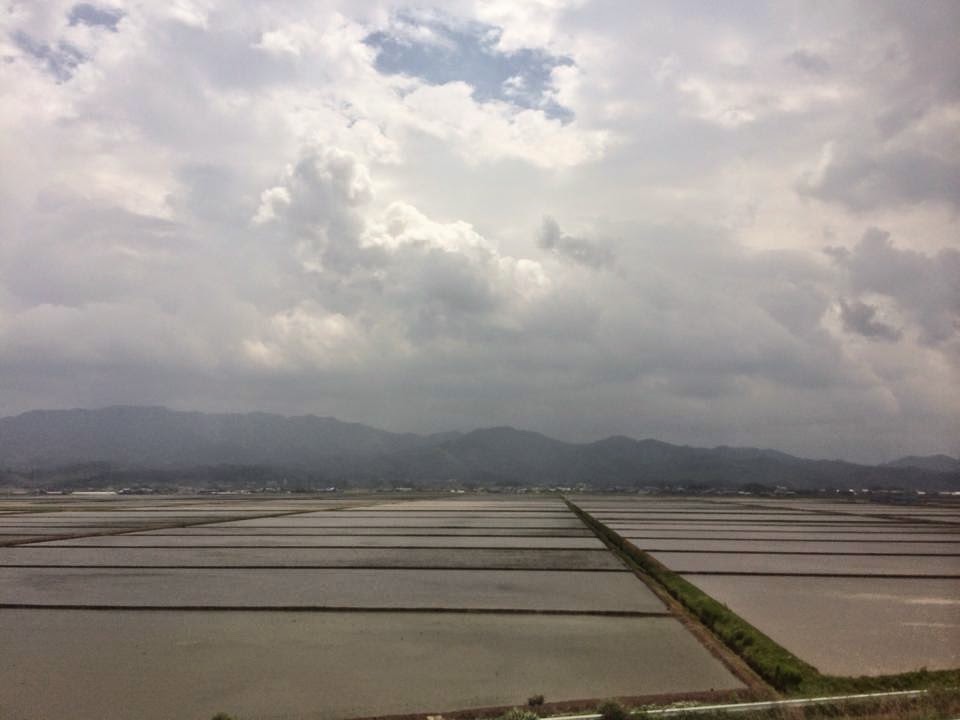
Two ducks sail the waves,
Riding out the tempest
In the rice paddy.
Riding out the tempest
In the rice paddy.

Zen master sea gulls
With their scolding cries of 'Now!'
Follow me from Sado.
With their scolding cries of 'Now!'
Follow me from Sado.

Flotilla of fleur-de-lys
Sails up the narrow stream,
Moving toward summer.
Sails up the narrow stream,
Moving toward summer.

After jumping the rooftops
Beneath the full spring moon,
Weary ninjas sleep in.
Beneath the full spring moon,
Weary ninjas sleep in.
On the turntable: Headlights, "Daytrotter Session"
Subscribe to:
Posts (Atom)