Showing posts with label Takenouchi Kaidō. Show all posts

Saturday, February 20, 2016

Takenouchi Kaido, End and Beginning


I had had a less than auspicious start.  Due to a late departure from home, I was forced to travel during the morning rush hour, something I am careful to avoid, an arrow-straight journey right through the heart of Osaka no less.  Standing on the platform to catch the loop line, I realized I was in the wrong place, but a quick sprint over to Nankai set me straight.  For some bizarre reason Yahoo Transit directed me to the wrong station, plonked me down in some nondescript housing development, from where it took a good ten minutes for a taxi to pass.   

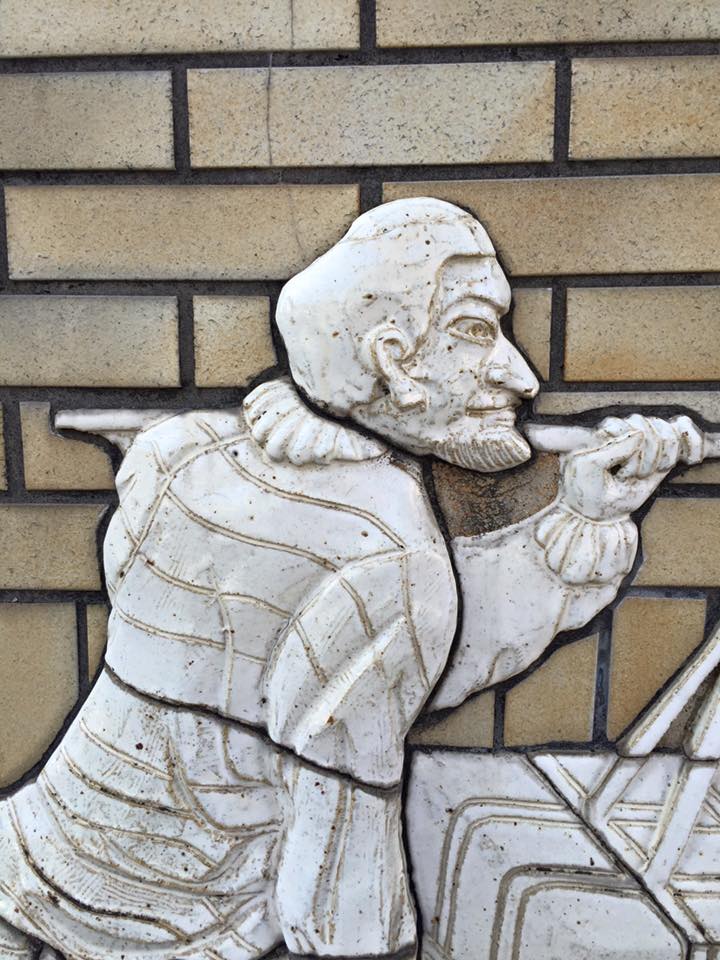
The Takenouchi Kaido traditionally started where Sakai Station currently stands, and after a futile attempt to find some kind of historic marker stone, I turned my back on the station and its massive adjoining shopping mall and walked into the sunlight.  Another unseasonably warm February day, in what was proving to be a warm El Nino winter.  It was pleasant going in mere shirt-sleeves, along Oshoji-tsuji, what this section had been called in latter eras.  The wall of a nearby primary school had a mural highlighting Sakai's connection to the bigger world, as it had once been the only port open to foreigners during the Warring States period.  These foreign sailors and missionaries were depicted with the same exaggerated probosces as the late Edo prints of centuries later. I followed my own nose past the restaurants and cafes coming to life in late morning, and after passing the station to which I'd errantly arrived earlier, I found myself in definitive suburban Japan.  

The walk from here was rather uneventful yet at least pretty straight forward.   The Kaido was signposted surprisingly well, and I only doubted myself twice.  Suburban developers pay little heed to old maps, and in both cases I was unsure of which parallel road to follow.  I had a fifty percent success rate, and when I did go wrong, I realized it immediately then quickly doubled back to walk the correct route.  (I missed it because had been admiring the old stone marker pointing me down the very path I wanted.  Looking at the finger, not the moon.)

Where the suburbs began to thin I found a sprawling park that served as a good lunch venue, and it was delightful to bisect the cherry trees and allow my feet a reprieve from asphalt.  Throughout the day I played connect the dots with the ancient tumuli that pockmark eastern Osaka prefecture. The massive tomb of Nintoku passed unseen just to the south, but later I sat a long while beside that of Yamato Takeru, whose heroic exploits settled the Yamato tribes firmly and definitely in this area.  The only nomads now were the migratory birds enjoying the sun-warmed waters of the ponds that the ancients had used for irrigation when this road was in its heyday.  

Aside from these, few other traces remained.  Little surprise considering the Takeuchi Kaido celebrated its 1400-year anniversary three years back. I enjoyed how the towns I passed through had an old Showa look, as if nothing has been touched since 1963.  I found this most exaggerated in the townof Furuichi, whose name can be translated as 'old market.'  That entrepreneurial spirit still exists in the form of shops in the form of suburban homes selling second-hand baby clothes, or functioning as cafes.  This American Country Boy lingered in front of one of the latter, called 'American Country,' but ultimately I moved on.   

The home stretch then began in Komagatani, a village whose pleasant look was the subtle darkened wood of Edo period temples and homes.  Beyond it, I was away from man-made structures for the first time all day, as the Takenouchi made its way to the pass that bears its name.  I would stop just short, having begun my walk with that very section years before.  As the final kilometer passed beneath my feet, I enjoyed having the twin peaks of Nijo just above me, as well as the higher reaches of the Katsuragi and Omine ranges further out.   The history of those places goes even further back, but my own place in that history has yet to begin.   


On the turntable:  Brian Ferry, "Taxi"
On the nighttable: Ian Baruma, "Anglomania"


Tuesday, December 22, 2015

Just Another Highway


One problem of writing on the internet is that you are restricted by the arbitrary confines of the Zeros and the Ones.  How do I label the walk I did today?  Nijo-zan (or at least its shoulder)?  The Takenouchi Kaidō?  Imai-cho?  In fact it was all of those.  But I'll settle on Takenouchi Kaidō, as I continued along that route for the better part of the day.

My second problem was getting a taxi.  I disembarked a small train platform in the middle of little, with no real desire to walk back up the pass that I'd crossed six years ago.  That problem cleared itself rather quickly with the appearance of a sleek black cab, driven by a youngish woman with dyed brown hair.  She took me to a small car park just over the Takenouchi pass, which contained a number of cars belonging presumably to hikers now somewhere on the flanks of Nijo-zan looming above.  I made for a trail at the back of the carpark and was on my own way.  

Problems as we know often come in threes. (Nay, scratch that, for the minuscule part of me that tends toward bravado says that there are no problems, only challenges.)   It wasn't long before I found myself up a path that wasn't on my map.  Served me right.  The roads of Japan themselves could be covered by all the flimsy little pamphlets and maps that you can pick up at railway stations and tourist offices, detailing hand-drawn walking courses with happy looking hikers and dancing mascots.  Sadly they are absolutely devoid of scale.  It reminded me of a quip I had read just the day before in Bill Bryson's "Notes from a Sun-burnt Country."  When asked peevishly by a local, "Can you not read a simple map?" Bryson replied, "I cannot read a simple map.  I can read a good map."  

As it was I found myself well-up the wrong trail, having been thrown off by an unexpected fork.  A nice bit of irony there since it was a series of forks that had contributed to a rather surprising amount of weight gain on a recent trip abroad, and as such, I suppose I didn't much mind the sweaty slog up a very steep pitch.   When I reached the top of something called Mukai-yama, and knew instantly that I was mukai-ing the wrong damn way.

I found the descent about as steep as the ascent.  When I met the main trail again, I turned left in the direction of where the wild boars had been digging.   On the taxi ride up here, I had been thinking about how apprehensive I have become when heading into the hills alone.  I'm not sure just why that is, considering I spend so much time up there, though that is usually in the company of others, and while on the job, fear tends to escape me.  Perhaps it is because of the night Wes and I spent on that snowy peak, or too many encounters with bears and venomous snakes.  But something gets stirred up inside me when I think about solo hikes in the hills.  My years of teaching yoga have taught me that there is indeed such a thing as muscle memory, and I am starting to believe that there is adrenal memory as well. 

I found the correct trail in minutes, which led me up to Shikaya-dera ato.  From the name I had anticipated a few remnants of an old temple, but what I found was of such antiquity that I gasped.  A tall weather-worn stone spire stood atop a col, directly before a small cave at the back of which was the figure of Amida Buddha scratched into its back wall.  I love Nara for things like this; the countryside is simply littered with them.  After a good fun scramble up a steep rocky trail I came to another set of Buddhist relics called Iwaya.  These were in the mouth of a cave, and holes bored into its upper lip hinted at a wooden structure that had once housed them.  They were now long gone.  Another impressive wooden structure had also once stood here, a massive cedar which had fallen somewhere around its 600th birthday.  The sound must have been impressive, for the tree still lay where it fell, a truly massive specimen under whose prostrate form the trail now passes.    

I made my way over the pass, and descended into what was a surprisingly lovely cedar grove.  Another surprise was the number of other hikers I met, close to a dozen over the hour I'd been hiking.  Most were past retirement age, enjoying a late season sunny day on the cusp of when the chills of winter would begin.  As I was passing a pair of women busy in conversation, one of them suddenly asked me, "Are you in Love?"

"Pardon?" I thought I had misunderstood.

"Renai is an old expression for love," her friend explained.

I had understood after all.  I didn't give an answer, but merely laughed at how her question had thrown me off-guard.  I continued in their company as we passed a small temple on the edge of the wood, then a couple of man-made ponds where men of their same generation were fishing.  As we went, we got to discussing the current political situation and I was quite brazen in expressing my opinion.  It had been a while since I'd talked to a Japanese person about anything, and my building frustration at the administration simply spilled out.  One of the women was quite engaged in the topic, but the one who had asked me about love seemed completely shut-down, her face now dour and closed.  When we reached their motorbikes parked beside a shrine, I tried to make amends by saying that all of these problem could be solved if we all chose to focus on the love in our life.  Not sure if it helped. 

I walked into sunshine again, through the back gate to Taima-dera, famed for its peonies. Their season was over, and thus so was their glory, but the sight of two or three flowers defiantly braving the cold had more impact than the sight of hundreds would have.  Beyond, a large statue of Amida meditated at the side of a pond, his face turned toward the sun.    

Below the garden were a trio of temple halls, one of which containing some of the most incredible statues I've ever seen.  The weathered and cracked face of the main Buddha simply stunned me, reminding me of why I am so enamored with the Nara period.  Buddhism was new then, and only deep and profound devotion can get to the heart of the intrinsic beauty that lies within wood or stone.  I stood fixed there for awhile, then remembered that I still had a long walk ahead.

I walked the narrow lane that led to the temple, then moved south to reconnect with the Takenouchi Kaidō.  It was chillier here on the plains, windy,  driven by the clouds laying like a shroud atop the peaks of Mt. Katsuragi.  In the half dozen times I've walked at her feet, the weather has always been like this, sun overhead, clouds on the peaks.  Little wonder that those heights are the birthplace of esoteric mountain Buddhism., and little wonder that the founder En-no-Gyoja is always represented with such a severe visage. 
 
I walked into the wind, colder than I had been up in the hills.  The road too had little to interest me, as I trudged along for the next two hours.  At one point the road left behind the chain stores and narrowed to the width of an old post road.  Yet even then, the houses were mostly of a new construction, the few older ones abandoned and in disrepair.  It all lacked charm, but I knew where that charm remained. 


On the outskirts of Yamoto-Yagi I detoured slightly to the south.  I had done so 20 years before, hopping off a train to visit its Imai-cho, which a guidebook had told me was composed mainly of old Edo-period structures.  On that day I had only had an hour or so between trains, so I literally ran to the town and back, getting only a quick glimpse.  Today I could take my time with the place, but was concerned with what two decades may have brought.   

They brought delight.  Imai-cho's tightly packed grids of narrow lanes had hardly been touched at all.  It was the Japan that we all long to see, the Japan that we all come here for.  The town had been one of the wealthiest during the Edo-period, which could account for the compact look of the town, making it easier to defend. Remnants of that wealth survived in the luxury cars parked here and there. 

It is incredible the lengths they have gone to keep the beauty, and preserve what they once had.  It was refreshing to see the workmen painstakingly rebuild some of the houses, taking great care to preserve the original look.  There were a few amenities to the modern world of course, like one house where they were putting in double-glazed panes.  I wish I could say that all the houses had retained the old look.  The single striking exception was the Yamada house on 4-chome, which looked nothing more than the worst European gingerbread delusion.  I can only imagine how Yamada's neighbors felt about the structure, no doubt with a fair bit of vehemence.  But what worries me more is that this is probably how it begins.  As one house goes, so does another, and another, and within a generation, this town will be filled with the least-common-denominator characterless boxes that Japanese all too often call home.  There were also a couple of places where houses were completely gone, converted to carparks.  But with the grassy surfaces, they were softer here, looking part of the town rather than as a conspicuous absence, as carparks usually do in Kyoto. 
    
The wind was blowing down the narrow lanes, under a sky gone grey.  The only true color in view was in the bobbing yellow hats of schoolkids going home.  Back on the Takenouchi Kaidō (from here called the Yokōji road), I found their older counterparts pouring out of the city train station after a long day in Osakan office buildings.  It was late now, later than I usually walk, the clock hitting 5:30 just as I found the intersection with the Shimotsumichi that I had walked past a year and a half before.  I said a quick hello to the caretaker I'd met on that day, then turned right and toward the south.  

Kashima Jingu, and its train station were a half an hour away.  Walking these last steps upon ever darkening streets was right out of my greatest samurai film fantasies, where the lone swordsman is walking down a quiet Edo lane, about to be ambushed by a dozen enemies.  I truly was walking back into the past, but the past I was walking into was my own.


On the turntable:  "Soulive and Jon Scofield, "Live" 
On the nighttable:  Sean Condon, "Sean and David's Long Drive"

Thursday, August 13, 2009

Takenouchi Kaido


The heat had come back. And with it, David Attenborough. When the simple act of making a decision caused me to break a sweat, I returned to my tried and true method of beating the heat: watching the BBC documentary, 'Blue Planet.' The underwater photography creates a psychological feeling of coolness, as if you yourself are underwater.

Deciding then that all the sitting around contained the risk of my taking on the size of the cetaceans drifting across my TV screen, it was time for a walk.

I chose the Takenouchi Kaidō, which is just north of the Katsuragi Kaido that I had walked in June. I left the train in one of those bedroom towns that are the cul-de-sac of dreams. Today was the official start to Obon, and the few people I passed were gearing up for the holiday, carrying flowers and decorating graves and jizo. At the corner in front of a school was a makeshift site with flowers, drinks, and two crossed baseball bats. I'm guessing that a child had been hit by a car here, poor thing.

The town seemed to take great pride in this Kaido, which goes back to the year 613. There were frequent stone markers and, like other old Osaka roads, the asphalt was a different color than usual, making it very easy to follow. In fact it followed a different route than that in my guidebook, one that mercifully kept me off of busy roads for the most part. It led me out of the new town and climbed a narrow road lined on both sides with Edo-style homes that had probably been inns for travelers. Above this was a small museum with displays on the Kaidō's history.

Leaving the 19th Century, I came to the inevitable busy road that I was forced to follow up and over the pass. It was a dismal hour, but for the stones and Buddhas at the top. Just below, I passed a guy dressed like a civil servant, wearing the wrong shoes and holding a newspaper close to his face like he was on the train. A couple times a year I'll come across people like this, who look suspiciously out of place, and it spooks me every time.

Once on the other side of the pass I was in Edo again. There was a small museum to Basho, who had also walked this route. The banana tree in the garden was a nice touch. At the bottom of the road was a magical forest. I expected to find a shrine under the dark trees, but there was none. Bizarre, this ancient grove in the middle of prime suburban real estate.

As if on cue, the valley in front of me was fast filling with storm. The Katsuragi peaks looked their part as the lair of wizards. As I waited for my train, I felt that this road, despite its age, had been minor, though it served as a nice 2 hour diversion. And here at the end of this post, I feel like I have nothing new to add; these walks are starting to get more and more similar. There was the usual busy road, the obligatory beautifully maintained street, the typical confusion.

It was at that moment that I saw the Tengu...


On the turntable: Miles Davis, "Complete Miles at Montreaux"
On the nighttable: Frederik L. Schodt, "Native American in the Land of the Shogun"
On the reel table: "Lagaan" (Gowaricker, 2001)