

Jazz & The Spoken Word returns to Kyoto on July 1st. My own words (and the Rexroth intro) last time...
https://www.writersinkyoto.com/2022/06/jazz-and-the-spoken-word/
On the turntable: Hasil Adkins, "Chicken Walk"

Jazz & The Spoken Word returns to Kyoto on July 1st. My own words (and the Rexroth intro) last time...
https://www.writersinkyoto.com/2022/06/jazz-and-the-spoken-word/
On the turntable: Hasil Adkins, "Chicken Walk"
"I think America is where all that was going wrong in the world was being nurtured."
On the turntable: "Bullitt OST"
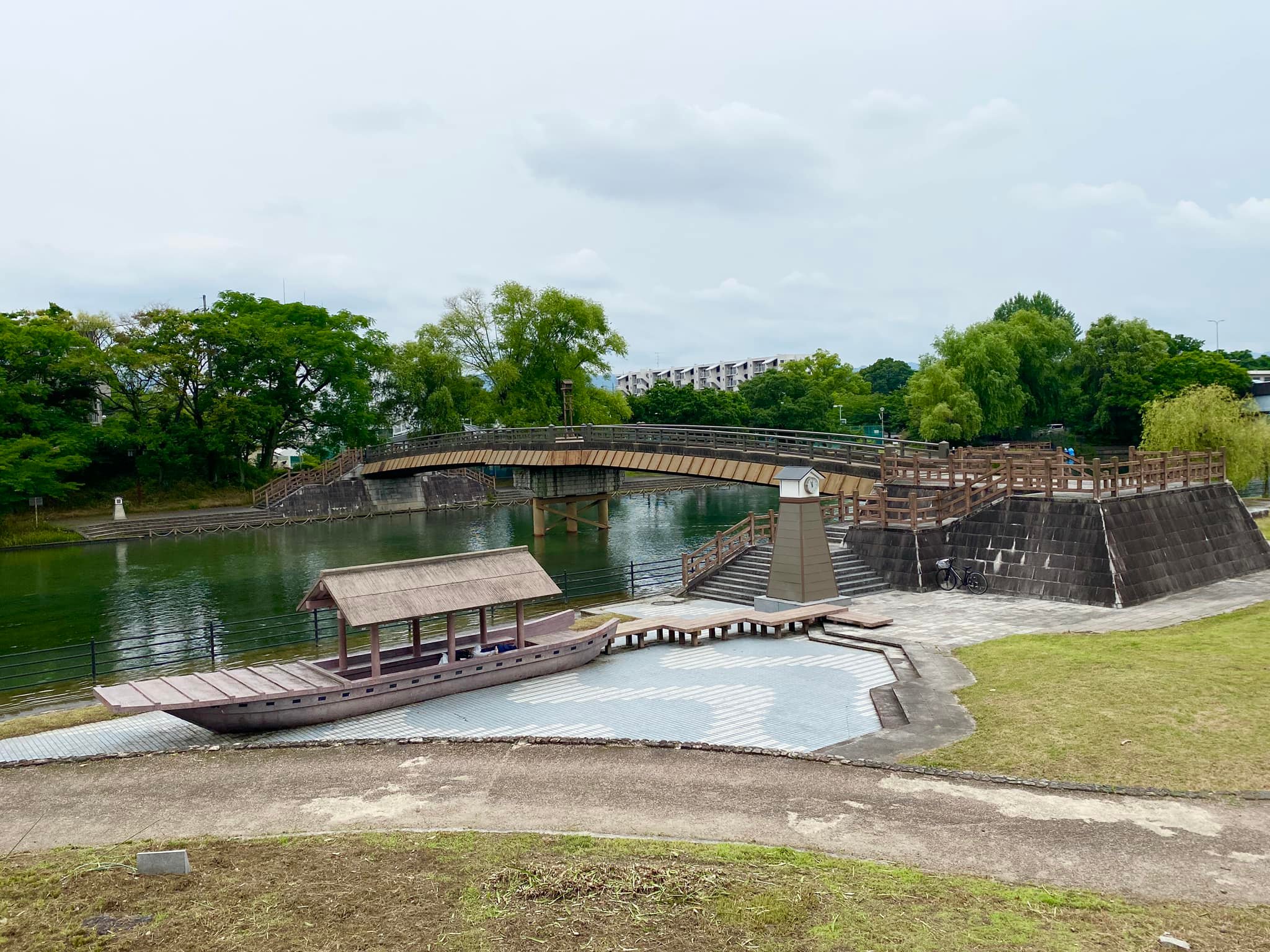
The Kyō Kaidō map I recently found kept me busy throughout June, and this morning I would set out on the last of the walks it detailed. My plan all along had been to do it before the heat of summer truly set in, under the umbrella of overcast skies of rainy season. And this final walk was in some ways most important.
When I'd set out 18 months ago to follow Akechi Mitsuhide on his wild ride from Shōryūji Castle to his safe haven beside Lake Biwa, I'd followed a route that was the most direct, or looked the most interesting. But knowing now that this final route does exist, it would have been his most likely route, had he not been murdered in the thickets en route.
As my feet fell upon it, I wasn't yet sure what this particular route had been called, and it was to my surprise that I later discovered that it too was known as the Nara Kaidō, the pseudonym of last week's Fushimi Kaidō. Further research showed that the Nara Kaidō was a collective name of roads emanating toward the eponymous old capital. I presumed that this particular one had served as an old bypass of sorts, allowing travellers from Osaka to head directly to the Tokaidō, without passing through Kyoto.
I'd started tired from a physically busy week and it showed in a lack of enthusiasm. Not long after leaving Yodo Station, I passed an off-road motorbike with two flat tires almost melded to the sidewalk. I felt nearly as flat. The massive behemoth being built beside JFA racetrack was a forest of cranes, and I felt for the toddler I saw in his mother's arms, young enough that this accompanying din of construction right off his doorstep would have always been part of his short life.
All in all it was pretty industrial along this first stretch. The houses that did exist were down little stumps of alleys, but a good many had a faux-brick look with trellising that took me to the antebellum South, the look of New Orleans, of Columbia, South Carolina. At the head of one of these stumps was a single grave, for warriors killed in the Battle of Toba-Fushimi, though the actual dead were still somewhere beneath the race course across the way.
Where the houses let up a mountain arose. This enormous pile of slag was many stories tall, with a bulldozer pushing the grey stones around and around. The smoke rising from its vertical exhaust pipe, set against the grey of earth and sky, was a scene right out of the English Midlands in the 1970's. It was a far cry from the many centuries when all of this was rice fields.
The road led me over the tracks to a smaller lane that took me along a berm that towered above the Uji River. This confirmed my feelings I'd done this walk 15 years before, albeit in the other direction. The scenery certainly hadn't gotten much better in the interval. I did like the look of the river when it receded to the point that its banks looked like the walls of a canyon, the water running listlessly through it. Here too was a landscape from another place, a beautifully self-contained little ecosystem. The riverbed itself must have been 300-400 meters across, but it had been whittled down to this little canyon.
I passed a group of a dozen men in JR jackets, collectively overseeing the flight of a drone. It probably caught me on camera as I squeezed through a do not enter barrier that tried to prevent me from crossing a narrow concrete pedestrian bridge that spanned the river. Every step was accompanied by internal visions of breaking through and falling into the water below.
I was just across the river from the park where I'd found Nobunaga's gravestone. What I hadn't seen that day was a series of floodgates, which had high pilings above, much like Tower Bridge in London. I assume they were Meiji, or perhaps early Showa, to judge from the matching buildings (now a technology museum), and the wrought-iron bridge further along.
Into Chushojima again, along an attractive tree-lined path following the canals. Here and there were old Tateba, places that allowed feudal period travellers to take a rest. This was a far better route than that of last week, and led me straight into the quaint heart of Fushimi town. I had my obligatory lunch and beer at Yamorido, a perfectly timed break one-third of the way along.
Getting out of town though proved a horrible slog. I circled back around to the Kangetsu Bridge, named for one of Toyotomi Hideyoshi's moon viewing parties, then straight arrow to the east, passing near Sanyaso, where that same warlord had built a platform for viewing that same celestial body. Above me in the hills somewhere were the tombs of two emperors, and the remains of Hideyoshi's Fushimi Momoyama castle.
These ruins lined the next half hour of my walk, though nothing really remained, but for the odd marker, included one buried to the hilt in concrete. More prominent were suburban homes, and the JR line. These escorted me through Rokujizo proper, before biding my leave at a built up shopping street at that station's far side.
The road narrowed and grew busy, with no sidewalks to protect from the rushing traffic, especially the wing mirrors of trucks which brought the danger of imminent decapitation. I was given reprieve by the quiet and shaded canal frontage of Daigo-ji. It was just to the west where Mitsuhide had met his demise.
The road undulated gently as it moved along the hillside. I was growing weary now, the humidity high. I jaywalked before a unnoticed police box, and not long afterward was a faded billboard for a college for police dogs. I sleepwalked past Zuishin-in and its famous plum garden, the road growing narrower, quieter, before meeting Higechaya Oiwake and the Tokaidō.
From here Mitsuhide's troops would have continued west along the Tokaidō, rather than cut over the mountains as I had. Though at that time, the road would have been a mere shadow of the grand trunk road it would become a decade later. But I've already twice followed routes into Ōtsu, and quite frankly, I'd had enough for the day.
On the turntable: The Beat, "Special Beat Service"

On the surface it looked to be just a nondescript grassy hill, though a bit incongruous standing as it was in a quiet neighborhood. As ever, the truth lay beneath the surface, in the form of 38,000 ears noses taken in the late 16th century Korean invasion, by Japanese troops who had ultimately fought to a stalemate. War trophies were important in those days, and noses proved much easier to bring home than entire heads, as was the practice of the time.
Kyoto's Mimizuka was quiet this morning, as the Korean tour buses that were often parked in front had been missing since the early days of the pandemic. I passed the mound heading south, following the Fushimi Kaidō, a medieval post road built by Toyotomi Hideyoshi, whose same aforementioned troops had attempted to invade the Asian mainland. I wondered if the mound had been a point of pride for people during the time of that war. (And the one after. And the one after that, ad nauseum.) But the only nose I was interested in was my own, hoping to protect it from burning under the early summer sun.
For most of its length, the Fushimi Kaidō is also known as the Nara Kaidō, as it ultimately led to that grand old city. I doubted that the woman walking ahead of me would make it that far, wearing a leather skirt and black tights, on a day that would hit 30° C.
I detoured over to Yōgen-in temple to have a look at its famous wooden doors, designed by Tawaraya Sōtatsu, one of the co-founders of the 16th Century Rinpa School of painting Most impressive was a pair of white elephants, though there was no mention of their
cost. The temple had been built from the remains of Hideyoshi's Fushimi Castle, right down to the blood-stained hand prints clearly visible on the ceiling above.
Returning to the old road, I moved through a quasi-urban neighborhood broken by the odd temple or antiquated hotel. It was too early for the Sloth hookah cafe, but a few baseball cap-wearing old timers were moving slowly to destinations all their own. Perhaps one of these was an old porn theater, whose type you don't see much anymore.
The rail line called for an up and over, and from here I was in the Tofuku-ji area. I caught the scent of sawdust from a now-flattened house. Besides the famed eponymous temple, there weren't many traces of history, and the neighborhood looked pretty poor. More than preserving a historical aesthetic, the emphasis here was no doubt more on survival.
A cluster of restaurants grew around the temple itself, to form a village of sorts. The first sign that this was a post road was the marker for an old bridge, now buried beneath a concrete overpass. Google Maps let me down in directing me up a few dead end alleys, and it took a fair amount of backtracking and circling around to get to Reiun-in. And found it arbitrarily closed, as seems to happen in Kyoto and nowhere else. Impermanence as expressed by indifference.
I attempted to drown my sorrows in lunch at Dragon Burger, but they've discontinued their wonderful sliders, which was my main impetus in the first place. Then further along around Inari station, I found that a favorite coffee shop, run by Pico Iyer's 'daughter' had temporarily closed to ride out the pandemic. I had chosen this particular day around the fact that all my waypoints should have been open, so was by now beginning to slide into one of those dark moods all too familiar to the long term expat. Yet in front of that Christian church south of Fushimi was the famous photo of a preteen survivor of the Hiroshima bombing, carrying his infant brother dead on his back. Things rapidly swung back into perspective.
I'd often walked or driven this section from Tofuku-ji down to Fushimi town, and had always liked its blend of old homes and Showa arcades. The problem with that familiarity was that my mind was frequently straying, and I wasn't completely keyed into the details. A few things did jump into eye. Like the Maison Noir painted a lovely shade of grey. Or the odd stones marking the former red light district near Tambabashi, some of the 'tea houses' hanging on until the 1990s.
Most noticeable was the interesting mix of the masked and unmasked, now that those particular health measures had been lifted. The people who weren't wearing masks were those who looked like they needed them most: unhealthy, damaged-looking characters. And everyone stuck to the shade. There is no such thing as social distancing on a hot sunny day.
The real action was happening in Fushimi proper. And yet again, I found myself skirting it. I traced the canals, but determined to return someday to walk the elaborate riverside trails themselves. I left the water and walked over the unpaved back alleys of Chushojima, arriving finally at Fushimi Port Park which I'd chosen as my southern terminus, though the Kaidō had ended a kilometer or so before.

I rested in the shade beside what is apparently one of the graves of Oda Nobunaga. Little surprise I suppose since fanboy Hideyoshi had moved his own retirement residence here. Then I began the return journey north along the Takeda Kaidō, which would lead me back to Kyoto Station. A great deal of fighting had occurred along this route, as the light of the Tokugawa Shogunate began to dim. I had an easier time of leaving town than these others had, barring one last detour that took me over to Yamarido to cool myself with a flight of their craft beer.
The Takeda proved a long slog. Not much was really happening until I crossed the Kamogawa, and came to a massive sake distillery. Besides that all else was cheap tile and concrete. I was beginning to hate this Route 24, and thought that there really was no reason for anyone to walk this. And traditionally they hadn't, for this road was built for the passage of goods loaded onto ox carts, while walkers took the Fushimi. As I often do, when the environs grow dull I turn to music. But Hal Willner's spoken word collection, Closed on Account of Rabies, based on the works of Edgar Allen Poe, was a poor choice for the bright sunny summer weather.
The sight of a side entrance to Jonangu reminded me that beside being a mere kilometer west of the Fushimi Kaidō, I was about the same distance east from the Kyo Kaidō of the previous week. Besides mulling that over, I tuned out completely. These are the worst kind of roads.
Finally I arrived at Kyoto Station, and crossed the rail tracks to the end of the Takeda. Steps away was the Honke Daiichi Asahi ramen shop, which was free of the massive queues that inevitably extend away from the place. Taxi drivers always marvel why, saying the noodles are terrible, and I assume some popular FoodTuber is too blame. Curious, I entered, and while it was a bit busy, I nabbed a seat. And found the noodles to be perfectly fine. But the cold beer was far better.
On the turntable: Lou Reed, "New York"
"Patriotism has nothing to do with Conservatism. It is actually the opposite of Conservatism, since it is a devotion to something that is always changing and yet is felt to be mystically the same. It is the bridge between the future and the past"
On the turntable: Rush, "2112"
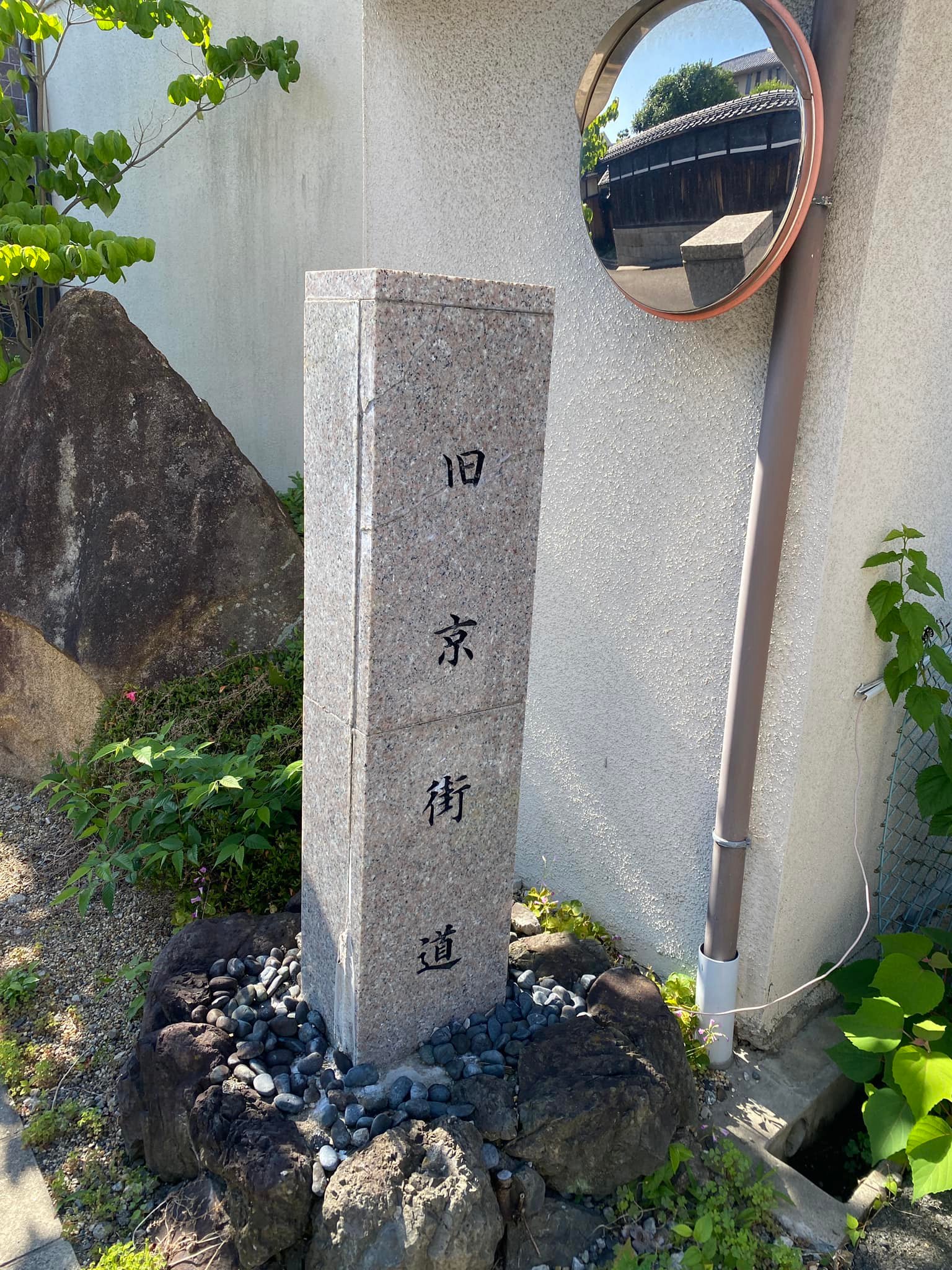
It promised to be a hot day, so I set off at the just-dawn hour when the crows begin their murder ballads. It took a bit of squirreling around with non-cooperative maps until I was able to get myself back to the Kyō Kaidō, picking up where I'd left off a week or so ago. I was happy to be led down the back-streets rather than the busy main drag up on the river berm, but just as I was admiring a nice old Edō period house, I was nearly flattened by a car blasting by. The hours between seven and nine are never good times to do road walks, a time when the oversleepers are inevitably racing by on their way to work. I realized a moment later that the rising sun was behind me, beaming straight into their eyes.
It was the work of destiny that I was here in the first place. I had assumed that my intended rail station was an express stop. It was literally at the station before that I realized that it wouldn't. With a quick shuffle of trains I was able to auto-correct. I was surprised because I had always thought that Iwashimizu-Hachimangu Station recieved all trains, due to the popular shrine on the hill above. The snarky side of my mind was wondering if they'd lost that status, as the surrounding neighborhoods were inhabited by the Japanese outcaste. And I wonder if the little kids that I saw walking to school in their colorful caps realized that fact yet.
I hadn't walked down here in quite awhile. I'm sure that when I last did, it wasn't filled with these pre-fab homes plastic looking homes abutting the river's berm. What I recall from memory was older homes, poorer homes, which is what gave me a clue in the first place to the social status of the area's residents. When I'd left the train earlier, a politician from the communist party was giving a campaign speech. They certainly knew their audience.
The next section around Hashimoto Station had the classical post road
look, filled with old homes and even the old Yukaku inn, where one could
stay for 3000 yen. The glory of this former red light district inn began to fade after the ferry
service was discontinued in 1962 (bridges previously unreliable due to
frequent flooding), but a recent renovation had brought it a vibrant,
retro look. The traditional aesthetic of the area appeared to be further
threatened, if indicated by a sign hanging before literally every house which stated opposition
to a proposed five-story apartment block threatening to come in.
I was fed onto a long stretch of busy highway that paralleled the rail line. As there was no sidewalk, I hugged the grassy edge, trying to make myself visible to oncoming vehicles. The land below I remember as rice fields, yet in a mere decade it had become a cramped suburb, complete with a small shopping mall. Riding the train to Osaka each week to teach my yoga class, I always looked forward to seeing the old Kushuon-in temple that sat alone, surrounded by those rice fields. Its symmetrical hall and front gate were lessons in aesthetic simplicity. Now I could barely see it at all, but for a slice of pitched tile, its ancient form now choked by all that prefab housing. Somewhere amidst the development was the site of the old Kuzuha river batteries, as well as some burial mounds. But I could see nothing but progress.
I left the highway and followed a quiet lane into Kuzuha, a town well marked by that enormous high-rise complete with heliport. It must have really rock and rolled in the 2018 quake. The map maker had me going straight across the railway tracks, which was physically, nay, legally impossible. So I just followed what constituted the high street in this bed town, lined with small bars, down which commuters would stumble home after the red lamps went out. It took some work to get back to the old road. Kuzuha station multi-tasked as a large shopping mall, and I kept looking for ways back across the tracks. But one after another proved to be dead ends. Finally after a lot of backtracking, I was able to return to the road proper, which was sadly the busy Route 13. It was proof yet again that Japan is no longer built to human scale.
At least this stretch had a sidewalk. The river was far away here, as the bank had been broadened to make room for a golf course. It looked like the golfers will soon be playing in the shadow of a massive flyover, now under construction. Oh, the hits just keep on coming.
An old low-income housing estate looked abandoned, its residents most likely relocated to the row of high rises right next door. The question remained: had society begun to better care for its less-privileged members, or had their number increased to the point that more housing was needed. I was tempted to ask one of the golfers, or perhaps the guy with the heliport.
The map had me walking straight across a culvert, leading me to believe that the mapmaker himself was Jesus. On the far bank I saw my first Jizo of the day, and a stone stele marking the old route back to the grand Iwashimizu Shrine. Not far to Hirakata now, the real jewel along the Kyō Kaidō. I appreciated that they made an effort to maintain a lot of the architecture, and I liked too how in those parts they hadn't, they'd built a arcade filled with charming shops that were still grounded in the needs of the local community. The road was well marked and free of power lines. After three hours near-nonstop walking, Hirakata returned the spring to my step. Alas it was over all too soon.
There was a feudal period house of a Edō vintage at the edge of town, but the glassed in upstairs hinted at Taishō renovations. I popped into the Kagiya Museum not far off for a quick look at the exhibits, then continued along. Just beyond, a spur line peeled off the true Kaidō. As I'd already walked the latter, I moved along this spur, but aside from the occasional old home here and there, it led me deeper into suburb. It eventually rejoined the main trunk route, which then stayed upon the bank of the Yodo river. This section too I'd walked back in 2009, so decided to jump ahead, following a narrow path to the nearest train station, which cut between a small canal and a solid wall of ticky-tacky houses.

I left the Osaka monorail an hour later near the banks of broad Yodogawa, the only time I'd see it all day. After a quick lunch under the a row of shade trees, I moved on through suburbs not much more inspiring than those before the train ride. But somewhere along the way the scenery began to take on a new look, as it passed through an array of older communities. Each train station was surrounded by what amounted to its own village, each worth exploring for half a day or more. Moriguchi was the nicest of these, with old stone staircases running up and down the town's low hills. It too cared for its history, the older structures renovated and given new life as shops or cafes.
And the road continued on like this for the duration. The vibrance of the surroundings distracted me from pain or fatigue, as the footfalls neared 30km. Being past noon the heat was up, but each town had its own covered arcade, which brought respite and more than a little Showa retro charm. I looked for a cafe for a stop and a rest, but my phone's battery was perilously low, and without the online map I might as well go home. So I powered on.
The signage was good here, far better cared for by Osaka than by Kyoto. Stone markers stood reliably where the road turned. One arcade had a powerful smell that brought greater Asia immediately to mind: that olfactory cocktail of fish, fruit, incense, and diesel. I lingered a moment in the doorway of a sword school that specialized in test cutting with live blades. Its sensei sat proudly at the back of the dojō, while a student washed the floor by pushing a wet rag along its length. I similarly paused before supermarkets, stealing a bit of second-hand AC leaking out from within the automated doors.
The older look eventually stopped around Kyōbashi, and all that was left was a final push along busier thoroughfares overshadowed by Osaka Castle. Not long after bisecting the grounds of the old feudal Kyobashi fish market which had stood here until 1915, I was pleased to come upon the stone stele that marked the true start of the Kumano Kōdō. Almost fifteen years ago I'd come up with the idea of following the waters from Kyoto to this point, trailing the boat journeys of Heian nobles a thousand years dead. Today I'd followed in the footsteps of the copycat Edō pilgrims five centuries later. It's hard not to appreciate closure, particularly when one isn't seeking any.
And then I was standing before the Riteigenpyō, reminiscent of Nihonbashi in being shadowed by a overhead expressway. And like its equivalent in Tokyo, this was the place from which distances were marked, if walking old kaidō like the Kumano Kiishū, the Chūgoku, and of course, the Kyō.
The best walks tend to finish near a watering hole, and Yellow Ape Craft served that purpose more than adequately. The day's heat made the first beer disappear near instantly, but while nursing the second I reflected on the walk, and how I could recommend nothing beyond a quick visit to Hirakata, and leapfrogging ahead by train to do that lovely stretch from Moriguchi to Kyōbashi. Done of course, in a much cooler season...
A map of the walk can be found here.
On the turntable: Her Name is Alive, "Someday my Blues will Cover the Earth"

I am very pleased that my piece, "The Man Who Stepped into Yesterday" has been included in this anthology, A Passion for Japan. Thank you again editor John Rucynski.
On the turntable: Phish, "Junta"

John Dougill writes:
"Yesterday saw the resumption of physical meetings for WiK with an At Home with Ted Taylor. There was a good turn out, with fourteen people in all, and the event started off with a tour of the house (which was built in 1986 as a Culture Centre) and an introduction to Ted's voluminous book collection. After refreshment the group listened to Ted talk of his lifelong love of travel and his devotion to travel writing. Not surprisingly given the nature of the group, there was a lively question period.

On the turntable: Jool Holland, "Best of Friends"

Time wounds all heels. Then time heals all wounds. The months pass, memory dulls. Forgotten is the monotony, the blisters, the pain in shoulder and hip. Then suddenly a new map pops up, and I'm once again lacing the sneakers in the genkan, one leg up like a stork.
Again, maps are the key. I've already walked so many of Kansai's old roads, but digital technology has improved exponentially upon my old guidebooks with their minute, hand-drawn attempts devoid of any scale. A recent online discovery shows that I had been misled a great deal along the Kyō Kaidō, and my curiousity (or perhaps ego), demands a rematch. I'd done two sections back in 2009 and 2013 respectively, and decide this time to orient myself toward Osaka, and walk into that city's heart.
I grab my buddy Joel to join on the first leg, as he is as keen on discovery as I, and we can stave off monotony with a flow of conversation that will carry us away from the more dismal sections. We leave the train at Kujō station, and walk west. I am happy to see that the old Minami-Kaikan has once again reverted to screening old classics of Euro-cinema, albeit in a new location. We decide to give Tō-ji a miss, taken more with the heron that peers into the murky moat, unperturbed by the steady flow of passers-by. We reach the small park that marks the site of the old Rajomon gate, the bare earth and lonely children's slide makes it seem almost as forlorn as the epic reproduction in Kurosawa's near eponymous film. Then again, it might just be the glooming overcast weather.
The road lumbers due south from here, along a diminished Senbon-dōri. At the dogleg stands little cluster of Jizō statues, probably moved here due to some past road construction. I had just been commenting to Joel about my love for old cities such as Rome, Athens, and Istanbul, where even the most casual of strolls has you stumbling over ancient stone relics. I had been pondering why a city as old as Kyoto doesn't have these things, but I'd indeed forgotten about Jizō.
Senbon proves a mismatch of architectural styles, as is common in modern Japan. This stretch has a good number of old Edo period wooden delights, and it also has bland, post-bubble cookie cutter clones. I'm quite taken with the rustic wooden Little Church on the Prairie look to the Assembly of God. The more I do these road walks, the more it dawns on me that rather than fret about the mundane nature of some of these places, particularly in the cities, I should appreciate that they express the variety of building styles that have arise over the last 150 years. Is that not in itself historic?
We cross the Kamogawa, then pass a stele marking the opening salvo of the Battle of Toba-Fushimi and the greater Bōshin War, that mopping up operation to root out the remaining Shogunate loyalists. Jōnan-gu Shrine is not far to our left, but we are more interested in getting to the river. Hunger is looming, and we hope to find a good grassy spot to picnic. There are a fair number of Edō-period houses, along the telltale four-meter width that marks a feudal road. Many properties have large, high walls surrounding their gardens. One wall has open gaps that lack the usual latticework, and I find its seeming lack of completion troubling somehow. Lush crops fill a garden of another sort, and it is refreshing to see that rather than with the usual plastic mulch, the stalks of the plants have been covered with straw in order to keep weeds at bay. Black plastic sheets do appear soon enough a short walk away, where the only crops at the moment are human boot prints.
We get to the river and our lunch spot, as storm clouds build over the mountains to the city's north. The air grows muggy as we continue along the high flood-control berms that protect the suburbs below. The humidity will rise to become slightly uncomfortable, as the early days of summer begin to assert themselves. There is a thatch-roofed temple, and a home built like an medieval castle, flanked defiantly by a neighboring window decorated in French Ironwork.
The Kaidō drops us back onto the tarmac again, which alternates between open vegetable fields and more clusters of little, two-story homes. The latter are almost cottages, colorfully attractive though standing linked shoulder to shoulder. While they face the river, the four-meter high berm prevents any chance of seeing water. I sense that this is a neighborhood for Japan's unmentionable untouchables, which is more or less confirmed by a stone marking the burial place of the war dead of the eastern army of the Battle of Toba-Fushimi. An old couple pulls down freshly cut boughs from a tree overhanging one house, while behind them, trash is piled high in the doorway. I sense that they are family to the owners, who are no doubt just as dead as the soldiers buried beneath the soil here.
We move inland at Yodo, where the odd historical signage reveals that this might have all been river at some point. We find the place where the Korea diplomatic dispatches disembarked their river launches prior to the long walk to Edō. There is the landlocked site of the Yodo Kobashi, and the equally high and dry Yodo waterwheel, documented by Engelbert Kaempfer when he accompanied the Dutch on an Edō-bound procession of their own. Our own road takes us through more and more modern suburb, whose main charm is in an ancient sakura standing atop a quiet bridge.
The next bridge is immense, spanning the Uji river racing in from the east. We follow it for the rest of the walk, an hour spent below the massive berm that rises to our left. The true road is atop it, but it is featureless, with a glut of cars. Far more preferable, and safer, to be down here with the reeds, and the resident birds. Joel is something of an amateur ornithologist, and he stops from time to time to hone in on a particular call, before whipping out the binoculars to get a better look at the soloist. His bird app provides the liner notes.
Just shy of where the Uji meets the Katsura, moments before their manage-a-trois with the Kizu, we exchange the road for a pair of rails. From here, the offspring of the three rivers is christened the Yodo. I walked this exact stretch in 2008, though I favored the riverbank itself. I'll be back before long, to see what she bears on her eastern shoreline.
On the turntable: The English Beat, "Bonus Beat"

https://shop.lonelyplanet.com/products/experience-japan
On the turntable: The Durutti Column, "Idiot Savants"
On the nighttable: Henri Charrière, "Papillon"
"Old punks don't die, they just stand at the back, nodding."
On the turntable: Rush, "Different Stages"

Watching
the world go by from a stoop in Gion, on an April day that hits 29° C.
Architecture bound in wires; delivery trucks unloading fish iced in
Styrofoam boxes; a pair of Geiko chat beneath parasols; the rigid gait
of a well-coiffed okamisan; and an older woman tumbles painfully into
the street.
On the turntable: Robyn Hitchcock, "Fegmania!"
"Trying to run Heisei with a Showa mindset is like retrofitting a Boeing 780 with propeller engines. It won't fly."
On the turntable: Ravi Shankar, "West Meets East "

On the turntable: Rick Wakeman, "Journey to the Centre of the Earth"

As we have the car, we detour over to Tamashima. Donald Richie never made it this far, though it was historically an important part of the region. The suffix shima hardly applies anymore, as nearby mountaintops gave their crowns to attach the former island to the outer suburbs of Kurashiki city. A narrow canal bisects the old town, though the proper sea is far off, out by those block-shaped man-made islands that extend to the south like a robotic prosthetic.
All of this is visible from the heights of Entsu-ji temple, whose picturesque grounds are filled with ponds, thatch buildings, and stone statuary that climb the hillside, all beneath spreading cherry trees. A torii-like gate formed by tree-trunks leads to an array of trails made for light hiking. As we make our way through the shade, I imagine myself in the footsteps of one of my Zen heroes, Ryokan, who trained here two centuries before. Stone figures silently watch as we spiral toward the top of the mountain, upon whose summit is a towering statue of Ryokan himself, at play with a group of children, as was his wont. The scale of the thing seems out of place with the simplicity of his life, and of his haiku:
The thief left it behind:
the moon
at my window.
Down at sea level, we walk through what had once been the center of Tamashima. The Saisō-tei was once the home of the Yunoki family, who ran the town on behalf of the Lord of Bitchu-Matsuyama, whose atmospheric and original castle still sits majestically in the mountains an hour from here. Among the displays within the house, I discovered that the reclamation went back as far as 1671, creating a important port which at its height hosted over 200 warehouses. None of these were visible today, but a handful of trade houses still existed across the canal in Nakaigai-cho, all repurposed into shops or trendy eateries. We did a quick spin through the area, before excitedly crossing the canal again to buy a gelato at a colorful little shop near the water.
On the turntable: Grateful Dead, "1983-04-12, Broome County Arena"
"Self-reflection is a vice best conducted in private or not at all."
On the turntable: Joep Beving, "Henosis"
On the nighttable: Soejima Teruto, "Free Jazz in Japan"

Thank you to Writers in Kyoto for hosting my latest piece, detailing an errant walk beneath Mt. Hiei:
Crawling Curmudgeonly along Hiei’s Eastern Hills
On the turntable: George Fenton, "Gandhi (Sdtk)"
"The relationship between tradition and change in Japan has always been complicated by the fact that change is in itself a tradition."
On the turntable: Poco, "The Very Best of Poco"

Thank you to Tokyo Weekender for publishing this piece on Japan's oldest road...
https://www.tokyoweekender.com/2022/02/tw-creatives-meet-the-new-gods-by-edward-j-taylor/
On the turntable: Paul McCartney, "Ram"

