Showing posts with label Basho. Show all posts

Wednesday, January 19, 2022

The Voyage of Basho


And from the "I totally forgot about this" file: 


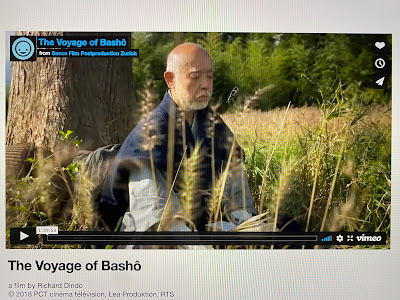
"The Voyage of Basho" is a 2018 release by the renowned Swiss director Richard Dindo. Shot throughout Japan over the course of a year, Roger Walch's photography is a visual feast. I am happy to have played a small role in the production, as "landscape counselor."

 Watch here.


On the turntable:  Quincy Jones, "In the Heat of the Night"


Monday, November 14, 2016

Narrow Road Signs XV


A lesson in the habits of air:

Nocturnal Autumn wind
Dances with the steam
Upon hot spring waters.


On the turntable:  Beck, "Mellow Gold"
On the nighttable:  George Orwell, "Coming up for Air"

Thursday, November 10, 2016

Narrow Road Signs XIV


The white of wings
Brilliant against a dark grey sky
Foreshadows the coming snow.


On the turntable:  Charles Lloyd, "All my Relations" 

Monday, November 07, 2016

Narrow Road Signs XIII


Itabi stones
Send heavenward their prayers,
In the company of ginkgos.


On the turntable:  Beck, "Odelay"
On the nighttable:  Janice P. Nimura, "Daughters of the Samurai"
 

Saturday, November 05, 2016

Narrow Road Signs XII


Cold winds from the west
Bring harrow to
Lingering summer grasses


On the turntable:   Bob Dylan, "Planet Waves"

Friday, November 04, 2016

Narrow Road Signs XI


Seen through the island's
Splayed branches of pine,
A sliver of moon.

On the turntable:  Can. "Unlimited Release"

Thursday, May 19, 2016

Narrow Road Signs X


Weeks come and go
Marshes ebb and flow.
Only gold can sway.


On the turntable:  Dave Van Ronk, "The Folkways Year 1959-1961"

Saturday, May 14, 2016

Narrow Road Signs IX


Reflections and
Decomposition.
Natagiri-toge.


On the turntable:  "Inside Llewyn Davis" (Sdtk)

Thursday, May 12, 2016

Narrow Road Signs VIII


刈草や兵どもが夢の跡
Cut grasses,
All that remains
Of warriors' dreams


On the turntable:  Dave Van Ronk, "Inside Dave Van Ronk"

Monday, May 09, 2016

Narrow Road Signs VII


暫時は滝に佇む夏の初め 
I linger awhile
Before the waterfall,
As summer begins.


On the turntable:  Beck, "Sea Change"

Sunday, May 08, 2016

Sunday Papers: Stephen Henry Gill


"When, unwittingly, a tiny frog once jumped into an ancient pond -- to be recorded for all posterity by Basho -- it never left."

On the turntable:  Anton Fier, "Blind Light" 
 

Saturday, April 23, 2016

Narrow Road Signs VI


As my feet point north
My thoughts linger on those
Suffering far south.


On the turntable:  Alison Brown, "Stolen Moments"

Friday, April 15, 2016

Narrow Road Signs V


Cleaner waltzes across
The station floor
Brushing calligraphy with a mop.


On the turntable:   Alice Coltrane, A Monastic Trio"

Wednesday, June 24, 2015

Narrow Road Signs IV


Awaiting the rains,
Lilies hold their proud heads
Above Basho's summer grasses.

On the turntable:  Pink Martini & Saori Yuki,  "1969"

Tuesday, February 24, 2015

Looking for the 'There' There Pt. V


There had been no initial clue as to why the train had been delayed.  After a half-hearted attempt at hitching, I found a taxi driver willing to take me to Morioka.  It was along the way that I learned about the earthquake.  And as my Shinkansen sped its way south, I learned of the tsunami, which at a mere ten centimeters lapped at a pair of harbor towns that had been scoured from existence nearly four years before.

How ironic than that I have chosen this day to continue the walk of the Tohoku coast that I had begun in June.   Due to some incorrect bus information, I wind up in another taxi, headed out to the small village of Onnagawa, nestled between a long low valley and an extremely craggy coast.  Berms are being built up along the former, which I presume had held most of the homes of the inhabitants.  Those who survived are being housed in a long row of shelters that must hold a hundred households, the sounds of which carry out over the rice fields that had for centuries heard little more than the hushed whisper of rice stalks. 

My driver tells me that this cab is one of eight donated to Ishinomaki by Okayama Prefecture.  When I had entered the taxi, he asked why I wished to go out to Onnagawa.  Last summer I had been too sheepish and ashamed to tell people why I was doing this walk, but today I apologetically confess that I am thinking about writing a book about the region's reconstruction.  So he drives slowly and thoughtfully, narrating along the way.  Where all I see is empty expanse stretching toward the east, he sees six decades of memory.   The pair of schools, the shops, the neighborhoods, all peopled by those now gone elsewhere.  I don't have the nerve to ask his story.  I don't dare.    

As we drive, I keep changing my destination. Part of the reason is that it has begun to rain, which had been a constant during those few days I'd spent walking in Iwate.  It seems fitting somehow.   And I'm again beginning to question my motives for coming.  Somewhere between last summer and today, I no longer remember the point.  

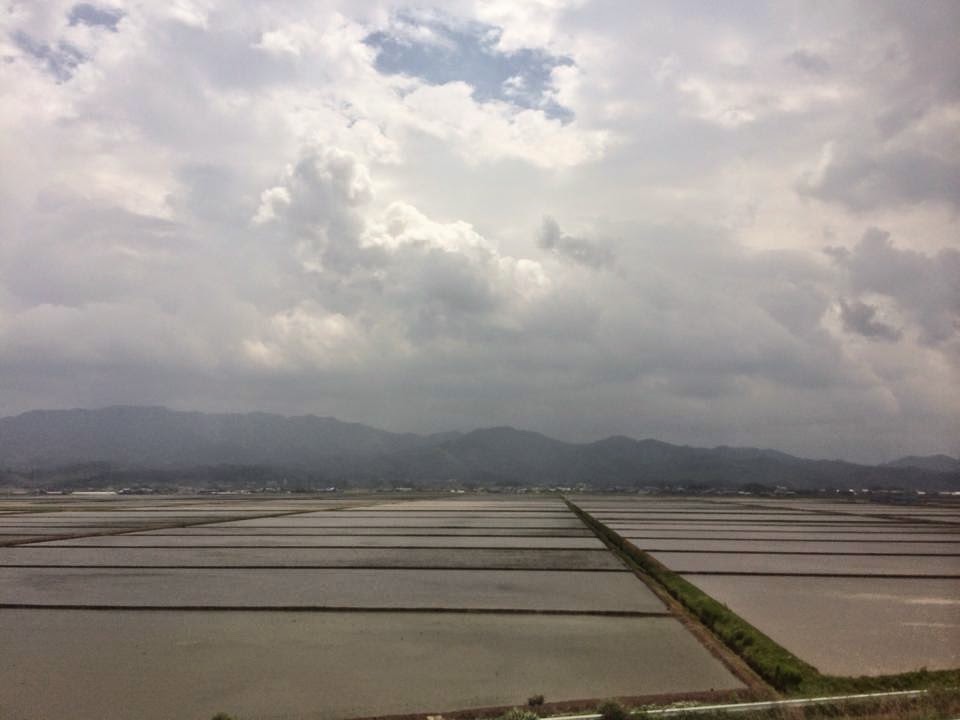
So I ride on, both road sides empty and green; the right side all neat rows of stubbled rice paddies, the left a twist of weeds and the odd squared foundation.  Will anyone ever return to claim this land?  

I arrive finally at a train station, serviced only by a few buses daily.  We parallel the rail line, past the air base that is the home to Japan's Blue Impulse air demonstration team, their bright and shiny machines parked atop high berms of their own.  On the outskirts of town, I see a handful of men squatting atop a new bridge, putting the finishing touches on the Senseki Line which is due to reopen this spring.  All the new concrete hints at the ferocity of the water that had moved through here, shifting these enormous heavy slabs.  This long low valley must have served as a funnel, for as at Onnagawa, I saw most of the damage in such a terrain.  And as the introduction of the locomotive helped assert over man the importance of clock time, so do these railway workers endure in their metaphoric turning back of the clock's hands.
  
I get off the bus in Matsushima.  I've guided here numerous times so give the town a miss, but do want to visit Oshima, whose old bridge had washed away, severing the historic link to the poet Basho and the generations of monks who'd confronted life's mysteries in the caves that pockmark the island.  A newly built bridge leads the way. Below me, tour boats trudge up and back, up and back, sluggishly feigning enthusiasm on such a cold wet day.  

I too drag myself toward Shiogama.  This was a particularly nasty piece of road, devoid of any sidewalk or shoulder to protect me from the barrage of trucks racing past.  I could completely understand why Basho had chosen to skip this stage and instead take the boat.  The hissing wake of passing vehicles sweeps me monotonously to a small train platform, and here I will quit for the day.   I've walked most of this next section between here and Tagajo, and less a reprieve for the feet as for the enthusiasm, which never showed up today. 


In yet another taxi the following morning in Tagajo.  Out amongst the hills to the west lies the ruins of what had once served as a sort of northern capital during the Nara period.  Not far away is another row of shelters.  One spring afternoon last year, the sight of a young girl my daughter's age playing amongst them brought tears, as I thought of the lost promise of what could of been. 

Aside from that I see no apparent damage nor reminder of the tsunami, though I know that this town had a significant loss of life.  And again I ride on, ride on, repeated my mantra of "Further, further," like one of Ken Kesey's somnambulic Pranksters.  The continuously poor weather conspires.  My heart is no longer in this walk.

I get out beside Sendai Airport.  Beside it, they are building a park called a Thousand Years of Hope.  They've actually created two hilly berms that resemble the ancient burial mounds of that aforementioned Nara period, upon which people are encouraged to come and watch the project.  These same mounds also serves as evacuation zones built as they are, ten meters high. 

And here beyond them are the new graves shiny and black, tucked into the corner of a large empty space.  This is the third time in two days that I've encountered this.  On what had once been a tidy suburban community, there was now only similarly aligned black stones.  I normally leave them alone, but today I feel I want to pay my respects. Each stone was not for a single person, but for an entire family, all born over a span of decades. And upon a few, rather than surnames, I find sentiment etched in marble: "Hope,"  or  "Souls united for eternity." Most painful are the graves of the children, so many, so many.  And the tears fall again, washed immediately away by the rain.  

And suddenly I'm angry.  What is being done in the memory of these people?  Each stone has been dedicated by a surviving family member, but what is being done for them?  Where are the rebuilt communities, the promise of a new start?  Where can it be found beneath all the talk of the Olympics, of Abenomics, of taking tougher stances against China,  terrorists, or even against a world demanding accountability for wartime 'improprieties,'  for the erosion of a free press, and for nuclear reactors still out of control.  I usually consider myself somewhat pragmatic on the latter topic, but now all I feel is that any talk of reactor restarts is an insult to the memory to these people lying here, and an even greater insult to those displaced nuclear refugees who face the far bigger challenge of living on.  I want to ask these men in government, "Mr. Abe, I know you've visited these stricken communities as a politician, but have you ever once come as a human being?"

My heart is no longer in this walk because my heart is breaking.

And my anger stays with me, as the diggers continue to scrape away at the land.  The question is "What have they been doing all this time," as even this particular project didn't get started until last September.  I'm sure there must be a good reason for the delay.  I know that it has nothing to do with these workmen who have been suffering the elements of various seasons.  But I want someone to explain to me, why has nothing been done out here for the last four years?

And with that, I'm done.  There are no answers here, nothing left to seek. 

But there is still one place left to see...


(Postscript:  A sort of answer can be found here.)


On the turntable:  "The Complete Stax"
On the nighttable:  Kyūya Fukada, "One Hundred Mountains (Martin Hood, trans.)"


Monday, May 19, 2014

Even Further on Basho's Narrow Road... (Narrow Road Signs III)


At the foot of prayers
Etched in stone:

Freshly cut grass.


Suzumebachi
Mimics the chanting of monks
Within the Benten hall


Petals upon the trail,
Envy the longevity of
The maples' fresh green.


Basho, Sora, Ekaku.
Companions drinking sake
On the rocks.


Two ducks sail the waves,
Riding out the tempest
In the rice paddy.


Zen master sea gulls
With their scolding cries of 'Now!'
Follow me from Sado.


Flotilla of fleur-de-lys
Sails up the narrow stream,
Moving toward summer.


After jumping the rooftops
Beneath the full spring moon,
Weary ninjas sleep in.


On the turntable:  Headlights, "Daytrotter Session"


Wednesday, March 26, 2014

Kuragari (Ise Hon-kaido I)


I stepped out of the subway station, and look slightly up the hill toward the castle.  The grounds were a Pollock splatter of pink buds, but I didn't detour to investigate whether they were plum or cherry.  Probably the former, as the sakura weren't due for a another few days still.

I grabbed a cheap 380 yen bento, and walked over to Tamatsukuri Inari Shrine, sitting on the steps since benches weren't provided.  This area was once home to the craftsmen who had carved the magatama jewels that were so sacred to the ancient Japanese.  Today, it was a quiet neighborhood, that still held the same slightly working class vibe, personified I suppose by the man who'd made my lunch.  

More importantly, this shrine was the Osaka terminus of the Ise Kaidō.  Just what I needed, yet another road to walk.  I was already in the process of walking a couple of others.  But this particular old path received priority status as it was considered most auspicious to undertake the Ise pilgrimage in a year following the shrine's renewal, a fact I learned from a recent post on my friend John's Green Shinto blog.  I had already planned to walk the Ise-ji section of the Kumano Kodō later this autumn, but now I felt compelled to undertake this parallel, 170 km road as well.  Good thing I bought new shoes last weekend.

I moved downhill, beneath a massive kusunoki standing in the middle of the road, then rejoined grand Nagahori-dori.  Signage was good here, and it led me seamlessly onto the smaller parallel streets that followed what in these early stages was referred to not yet as the Ise-Kaidō, but rather the Kuragari Kaidō, and old road that led from the capital Nara to an ancient part of modern Osaka called Kōraibashi.  The name was reminiscent somewhat of the word "Korea," proving an interesting linguistic parallel since it means Goryeo bridge, a reminder of the strong contacts between Nara and Korea at the time, and may even be where boats from the continent were moored.   

I was curious when the signage would end, and it didn't take long.  I was moving hesitantly into Higashi Osaka proper, along the busy Rte 15, or occasionally beneath the large factories lining the roads that flanked it.  Very run down and rough looking.  A couple of workmen in their 50s gave me a good glare as I passed.  The lack of signs made sense if you consider that it's difficult to care about history when it's hard enough just to focus on the day-to-day present.  


I had been long intrigued with this area, in particular with the section once called Kawachi, since it and its people had been the setting for Imamura Shōhei's first film called Stolen Desire.  The locations of the film reveal a small rural town surrounded by vast farmland.  Today it was all new, suburban, the absolute worst of Japanese development, right down to the rugby stadium in the middle of town, a testament to the rough and tumble people here.  Any time I passed a person of the film's vintage, I wondered if they might have been within Imamura's frame, as so many residents had been extras.  More important was the changes they must have seen during this last half century.   As I walked along, pondering this, Mt. Ikoma rose like a wall ahead of me.  

Before long I reached her feet.  I paid respects to Hiraoka shrine, as picnickers enjoyed the plum groves nearby.  I stepped back onto the concrete path of Route 308, which wound narrow and steep up the mountain's flank.  It wasn't a long ascent, but it was a tough one, forcing me to stop a few times.  I passed a couple of walkers coming the other way, each of whom nodded but didn't say anything as I came past.  Were they trying to emulate the holy men of old, taking some sort of vow of silence on the climb?  

I finally made it to the small hamlet up top, the tea house closed on this Monday.  I moved beyond it, to admire the view of the Nara basin beneath the seasonal haze.  Then quickly down the other side, past the fields and the Basho stone, the stone statues and the small temple halls. When my feet leveled out again, I was at a train station, tired, hungry, and foot-sore.  But the shoes had performed marvelously.  


MAP: http://latlonglab.yahoo.co.jp/route/watch?id=a1b3380854ca35b251629e89901729d1


On the turntable:  The Clash, "The Story of the Clash"
On the nighttable:  Rob Scheltheis, "Bone Games"

Tuesday, December 24, 2013

Yoshinaka and Tomoe at Rest


Visiting the graves of Kiso Yoshinaka and Tomoe Gozen, who rest quietly in a small forested hillside just off the Kiso Road. Tokuonji is a quiet temple, offering pleasant views of rice fields and a small river that narrows at it lengthens toward the upper reaches of Koma-ga-take.

There are four ancient graves in back.  Beneath one rests Tomoe, who in later life became a nun after the death and defeat of her warrior lover.  There's a stone for him as well, although his body is buried between Lake Biwa and the famed poet Basho.  Yoshinaka's head is reputed to be buried at Hōkanji in Kyoto, near the tall pagoda that punctuates the hilly streets leading up to Kiyomizudera. 

The graves overlook a small shrine, and a bronze statue of Tomoe on horseback.  It is easy to imagine her racing through a rain of arrows, her naginata twirling behind.  Modern archers practice in the kyūdōjō attached to the temple, shooting through the swirl of dragonflies, the rice stalks beyond bending toward autumn.


On the turntable:  The Yardbirds,  "The Very Best of...
On the nighttable:  John Dougill, "In Search of Japan's Hidden Christians"


Tuesday, November 05, 2013

Further on Basho's Narrow Road... (Narrow Road Signs II)


Rain soaked willows
Hang limp from weeping
 
Second-hand tears.


 Swirling swirling.
For three days the winds,
This morning the birds.


 Children deserve
Better than war;
I can offer only chestnuts.


Its lifts now silent,
The ski hill's only echo
Is the schussing of
susuki.


Where the Shogun found wealth
I find far more value
In the gold in the trees.


 On the turntable:  John Coltrane, "The Complete Impulse Studio Sessions"


Monday, July 01, 2013

Tohoku Sketches


...The sky was cloudy,  the weather and the landscape reminiscent of the British moor, open expanses of grass stretching away.  I was surprised at the amount of grass up here, far more than farther south.  New flowers pushed color toward the sky.  The dullness of stone found solidarity in the hues of the sky.   These itabi stones are new to me, these petitions for divine intervention, these appeals catholic in their pathos.  I'll run into them throughout my travels to the Far North.  Amongst them is the Tagajo stone, this little piece of the 8th Century that Basho so famously misread.  Tagajo Castle itself was on the hillock above, now bare but for a long flight of steps and foundation stones.  I sit atop the steps and eat lunch, reflecting on the passage of time and how the Passage of Time is itself passing.  Hard to imagine this Nara period outpost, on the edge of the Emishi wilderness, back in the days when Japan had a wilderness.  I find myself becoming quite intrigued by the Emishi.  I'll devour tales of their culture, their wars against the Yamato, as I pass through their lands, though the only real threat today are the bears that the signs are so ready to scare me with...

...Throughout Tohoku there is the palatable feel of the tsunami.  As I buy a coffee at the ferry terminal in Shiogama, I imagine what the jovial woman who hands me the cup experienced that day, in her shop mere meters from the sea.  Ironically, the islands of Matsushima Bay fared better with the rising water than they did with Japan Inc., who have left so many concrete monuments to wealth that the view is spoiled for me.  Matsushima town itself has erected marble stele and handwritten wooden signs showing the extent of the tsunami.  The quiet pine-lined entrance to Zuiganji is now the color of mud.  Looking at the caves here all I can imagine are the rakan statues treading water.  While walking along the sea earlier this morning, I met a carpenter involved in the long restoration project at the temple.  He tells me that the completion date has been pushed back a few years, since most the region's carpenters are involved in rebuilding the  communities destroyed along the coast... 

...In the lobby of my hotel are photos of the damage that it took two years ago.  And in the bath, I talk with a man who has come back for a memorial service.  It dawns on me that by the Japanese way of counting, this is the third anniversary of the deaths of the victims.  With such a large number of dead, the priests who themselves survived the disaster will be performing the 3-year memorial services daily for the better part of the year.  

...And the reminders continue as I move inland.  At train stations along the route are posters with information about bus services that have been created in order to replace the train lines that have washed away.  On the narrow roads, trucks rumble past, their trailers piled high with debris.  At my inn at Akakura Onsen, I chat with a group of old timers who take the baths as relief against age-related ailments.  They are warm and jovial, and all come from towns that no longer exist...

...the forest of ihai for the tsunami victims at Haguro-san, the song of the tsutsudori like the beat of the mokugyo, an accompaniment for the prayer in my heart.  I sit in similar silence out at Minamidani, taking in the chant of the frogs... 


On the turntable: "The Rough Guide to the Music of Iran"